How To Draft A Basic Bodice Block Pattern?

anicka.design Home » How To Draft A Basic Bodice Block Pattern?
4.9
(105)

To any sewist or fashion design student who wants a perfectly tailored bodice pattern. You too can use our math-free approach. Learn how to draft a bodice block that fits with confidence, and without frustration. Use with our free interactive bodice block tutorial and draft your basic block from scratch easily.

Project with easy difficulty.

How the interactive tutorial works in 3 easy steps

1. Fill in your measurements

2. Get a personalised tutorial

3. Download instantly without waiting

What’s included after you complete the interactive tutorial

Online tutorial

FREE

✓ Step-by-step illustrations

✓ Custom-fit drafting dimensions

✓ Formulas for calculated values

PDF tutorial

$2.99

✓ Step-by-step drafting illustrations

✓ Custom-fit drafting dimensions

✓ Formulas for calculated values

✓ Your measurements overview

✓ Approximate fabric consumption

What is a basic bodice block?

The basic bodice block (or basic bodice sloper), along with the basic skirt block, sleeve and dress block, is one of the fundamental patterns in fashion design. Once you’ve drafted your own custom-fit bodice sloper, you’ll have a perfect-fitting base for any design you dream up—tops, dresses, anything. By tweaking it with simple moves—like shifting darts, adding gathers, yokes or style lines—you can turn this one block into endless fashion designs.

This bodice is designed to be used with set-in a sleeve. The instructions for drafting the FRONT and BACK pattern piece are described separately. The reason for this is simple: I find it easier to understand the pattern construction steps if the two parts are described individually :).

This page contains the following:

Tools and tips before taking body measurements

If you are a beginner in creating your own patterns from scratch, I recommend marking some parts of your body before you measure yourself (or someone else). These markings will help you take the measurements more exactly. If you measure yourself, you might ask a friend to help you take measurements at your back. You will need the following:

An elastic band tied around the waist of a mannequin.

An elastic band to mark your natural waist (the most narrow part of your waist). Marking the waist is very helpful while taking various length measurements (see the image above).

Pins pinned to the various parts of the torso of a mannequin: shoulder beginning, shoulder tip, armscye centre and torso centre.

Small stickers or a marker to mark your shoulder. The beginning of the shoulder next to the base of the neck is a very important point from which multiple measurements are taken. If you use a tailor’s dummy as I do, you may also use pins (see the image above).

Taking body measurements

Take body measurements according to the illustrations below. While doing so, make sure your tape measure is neither too tight nor too loose.

  • Stand naturally: Maintain a natural posture without sucking in or pushing out any body parts.
  • Get help if needed: Some measurements at the back, like neck to waist, shoulder to waist or armscye centre width, might be easier to take with assistance.
  • Use an elastic band around your natural waist: it will help you with taking various length measurements.
  • Double-check: Measure twice to ensure accuracy.
  • mEnter the measured values into the tutorial designer below: this way you will get a custom step-by-step tutorial on drafting the basic bodice pattern.

How to draft a bodice block – interactive tutorial

Some values in the form below are highlighted in yellow. These have been automatically calculated from your measurements such as height, bust, or waist using standard body proportions and pattern-making guidelines. You can adjust any of them manually if your own measurements differ.

Need more time to gather your measurements? Download this bodice measurements cheat sheet: a one-page, print-ready PDF with clear illustrations. Fill it out at your own pace, then return to enter your measurements into the interactive tutorial below.

Body height

Overall body heigth.

Bust circumference

Your bust is smaller than your waist.
Bust circumference must be between 40 and 150 cm.
Ease at bust must be between 0 and 5 cm.
Your bust is smaller than your waist.
Bust circumference must be between 15 and 65 inches.
Ease at bust must be between 0 and 2 inches.
Measuring the bust circumference with a tape measure across its fullest part.

Natural waist circumference

Waist circumference is larger than bust circumference.
Waist circumference must be between 40 and 130 cm.
Ease at bust must be between 0 and 5 cm.
Waist circumference is larger than bust circumference.
Waist circumference must be between 15 and 52”.
Ease at bust must be between 0 and 2 ”.
Measuring the waist circumference with a tape measure.

Shoulder to waist length at the front
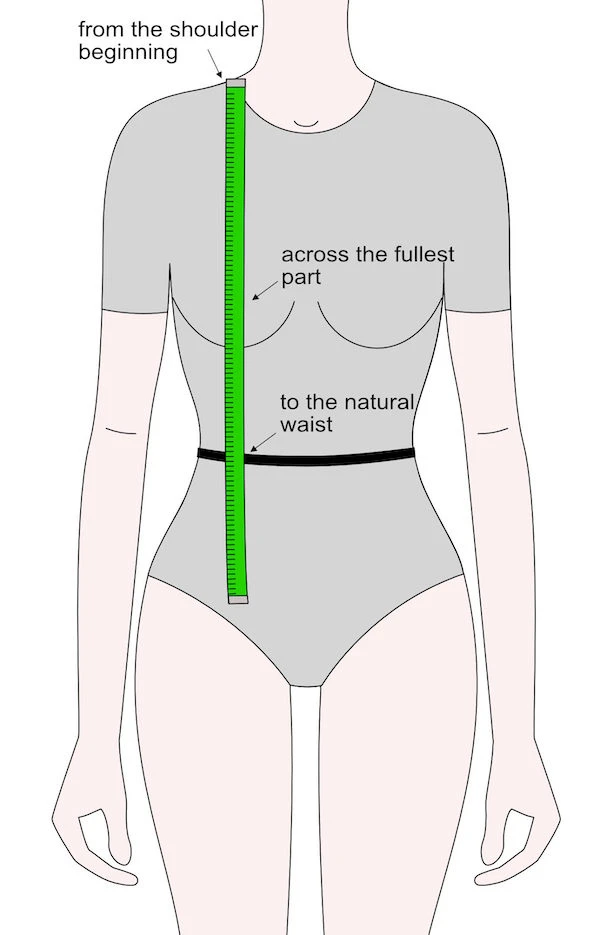
Shoulder to waist length must be between 25 and 100 cm.
Shoulder to waist length must be between 10 and 40”.
Measuring the bodice front length at the centre. That is: from the breastbone to the natural waist.

Neck to waist length at the front

Neck to waist length is longer than shoulder to waist length.
Neck to waist length must be between 25 and 100 cm.
Neck to waist length is longer than shoulder to waist length.
Neck to waist length must be between 10 and 40”.
Measuring the bodice front length at the centre. That is: from the breastbone to the natural waist.

Bust to waist length at the front

Bust to waist lenght is longer than neck to waist length.
Bust to waist length must be between 10 and 80 cm.
Bust to waist lenght is longer than neck to waist length.
Bust to waist length must be between 4 and 32”.
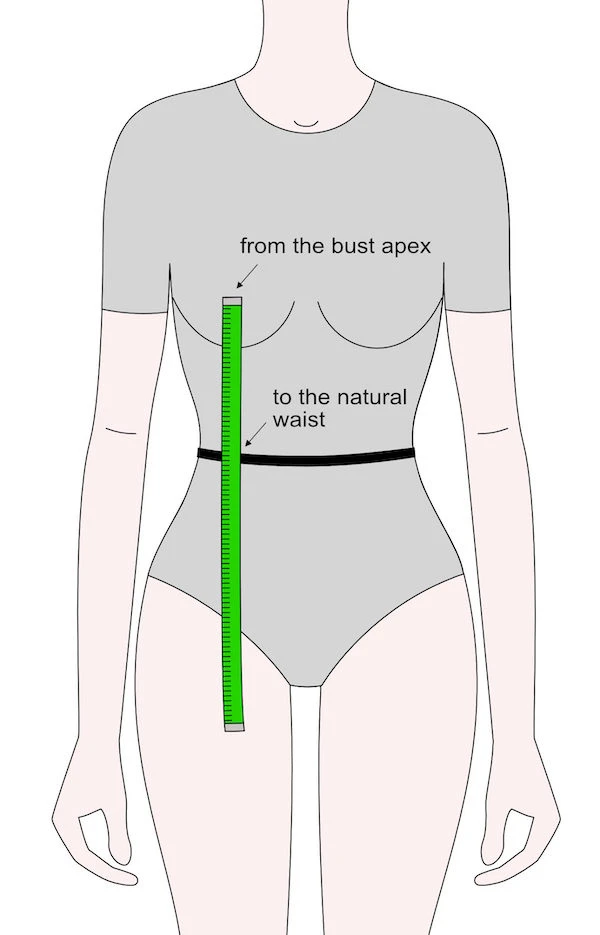
Measuring the bust to waist length using a tape measure.

Neck circumference

Neck circumference must be between 20 and 60 cm.
Neck circumference must be between 5 and 25”.
Measuring the neck circumference with a tape measure at its base.

Bust divergence

Bust divergence must be between 10 and 60 cm.
Bust divergence must be between 4 and 25”.
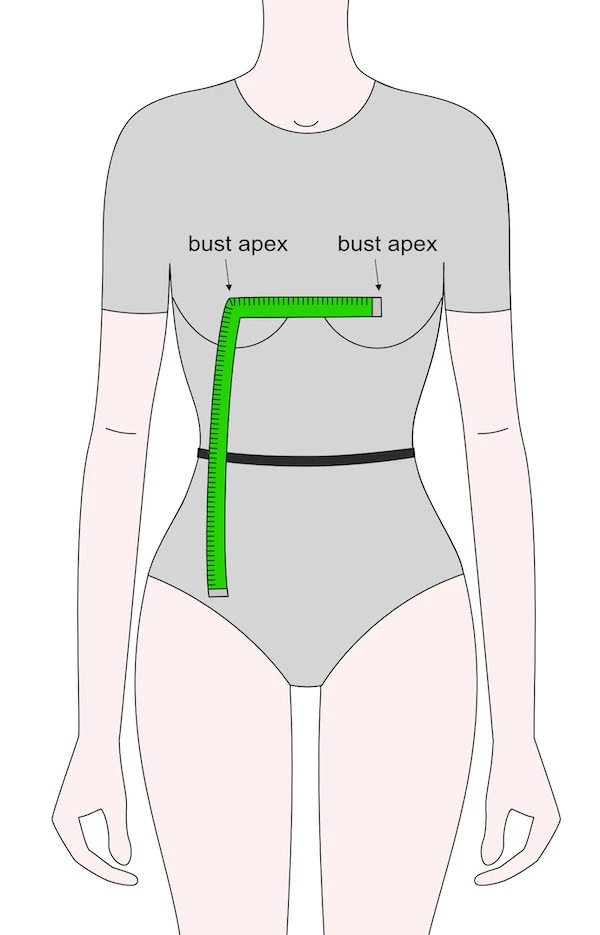
Measuring the bust divergence using a tape measure.

Armscye centre width at front

Armscye width must be between 10 and 60 cm.
Armscye width must be between 4 and 25”.
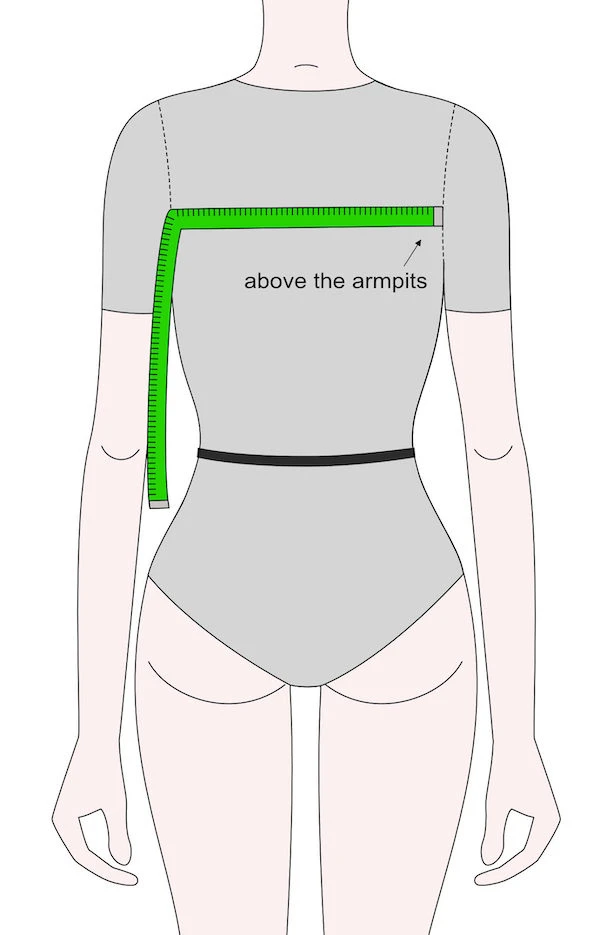
Measuring the width of the bodice at the front between the two armscyes.

Shoulder length

Shoulder length must be between 5 and 20 cm.
Shoulder length must be between 2 and 8”.
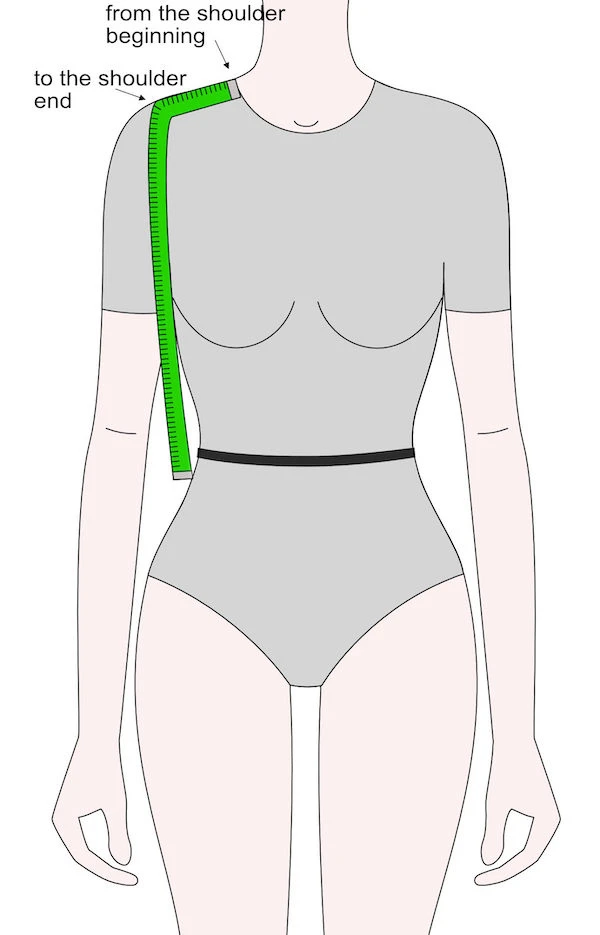
Measuring the length of the shoulder.

Shoulder slope

Shoulder slope must be between 0 and 10 cm.
Shoulder slope must be between 0 and 4”.
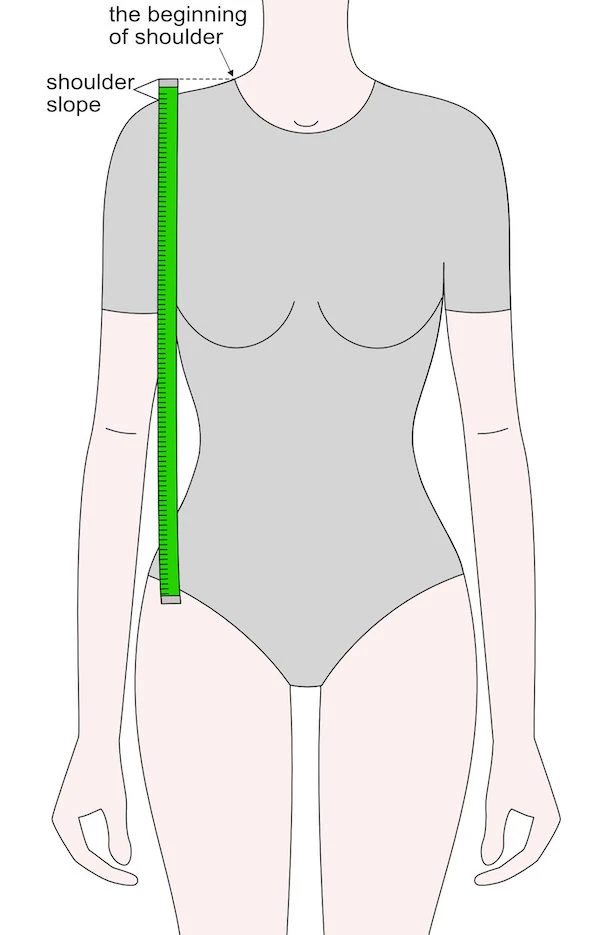
Measuring the slope of the soulder.

Armscye centre width at the back

Armscye width must be between 10 and 80 cm.
Armscye width must be between 10 and 32”.
Measuring the width of the bodice at the back between the two armscyes.

Shoulder to waist length at the back

Shoulder to waist length must be between 25 and 100 cm.
Shoulder to waist length must be between 10 and 40”.
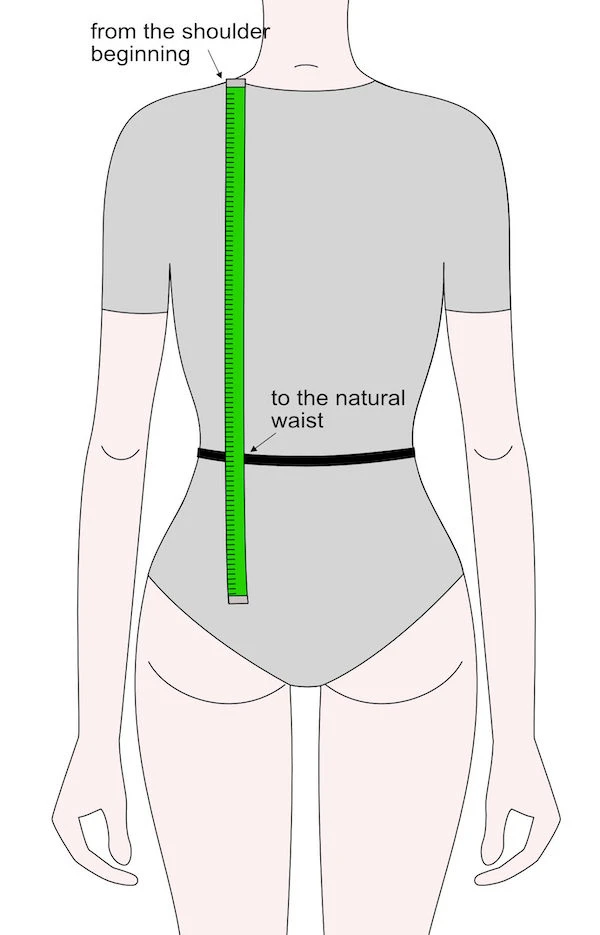
Measuring the bodice length from the shoulder to the waist.

Neck to waist length at the back

Neck to waist length is longer than shoulder to waist lenght.
Neck to waist length must be between 25 and 100 cm.
Neck to waist length is longer than shoulder to waist lenght.
Neck to waist length must be between 10 and 40”.
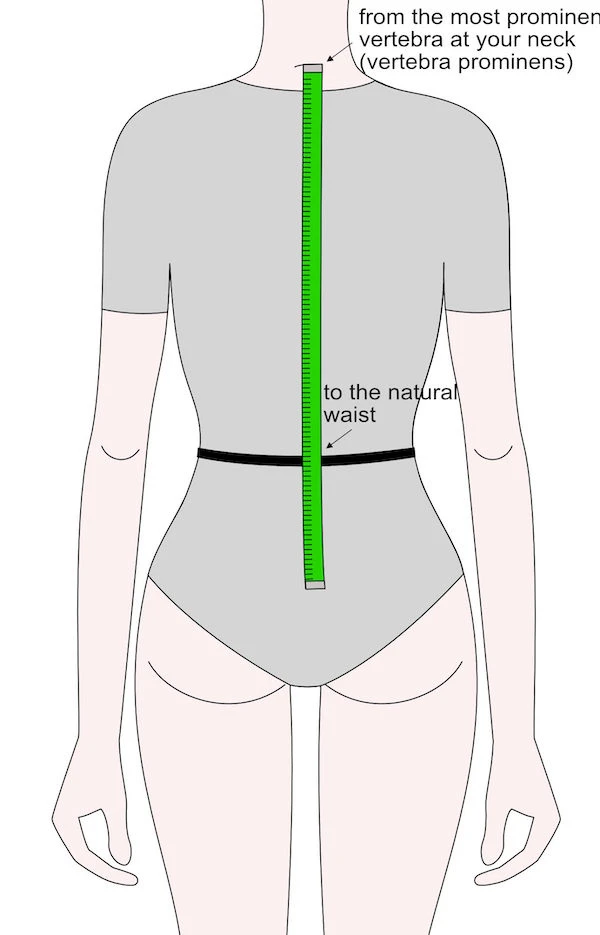
Measuring the bodice length from the neck to the natural waist.

Seam allowance

Maximum seam allowance is 3 cm.
Maximum seam allowance is 1”.
Please check and fix your measurements highlighted in red in order to proceed.

We do not store, nor share any data you put into the form above.

Get the best fit based on your body measurements

The shaping of a bodice depends on the difference between the bust and waist circumference, including ease. When the bust and waist measurements are equal, no shaping between the bust and waist is required. The bodice can be drafted without darts and with completely vertical side seams. As the bust–waist difference increases, more shaping is needed to fit the contours of the body. A small difference can be managed with a slight side seam intake, while a larger difference typically requires both side seam intakes and darts (see the table and images below).

Bust-waist difference (including ease)More than
3 1/8” (8 cm)
Less than or equal to
3 1/8” (8 cm)
No difference
Side seam intakeSide seam intakeSide seam intakeNo side seam intake
Darts at the waist1 FRONT + 1 BACK dartNo dartsNo darts
Table 1: division of bust and waist circumference between darts and side seam intakes.

How to draft the basic bodice block step-by-step

First, prepare these tools:

  • pencil
  • sharpie
  • large paper or tissue paper
  • long ruler
  • French curve ruler (useful, but optional)

In the instructions below, some of the lines are grey and some are black. I recommend drawing the grey lines with a pencil. These lines are mainly guidelines that will help you position individual points and parts of the pattern. The black lines are the ones of the pattern itself. Use a sharpie to draw them.

You can download a custom-made bodice pattern drafting PDF tutorial after entering your body measurements and clicking ‘Design Tutorial’ on this website’s pattern tutorial designer. This print-ready PDF will save you time, eliminating the need to write down any information from the webpage. It includes all your measured and computed values, along with step-by-step drafting images to guide you through the process.

If necessary, iron the tissue paper before drawing the pattern. Never use creased or crumpled paper for drawing patterns.


Learn to draft a basic sleeve block button.

How to draft the basic bodice block – BACK pattern piece
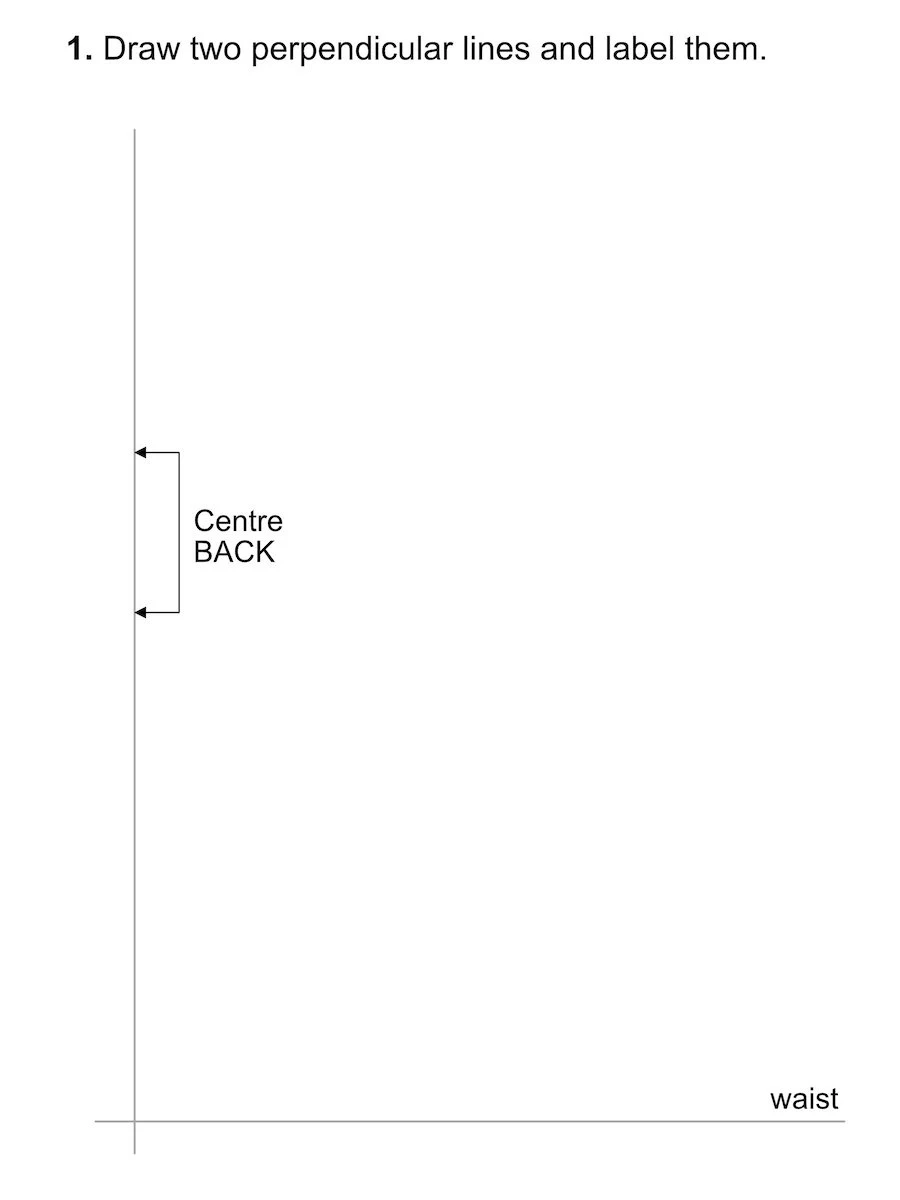
Drawing two perpendicular lines that will be the centre BACK and waist line of the basic bodice block pattern.

On a large sheet of paper, draw two perpendicular lines. The vertical one will be the centre BACK and the horizontal one will be the waistline.

Marking the shoulder to waist length at back measurement on the vertical line.
a

Draw according to the following measurement:


a = shoulder to waist length at BACK
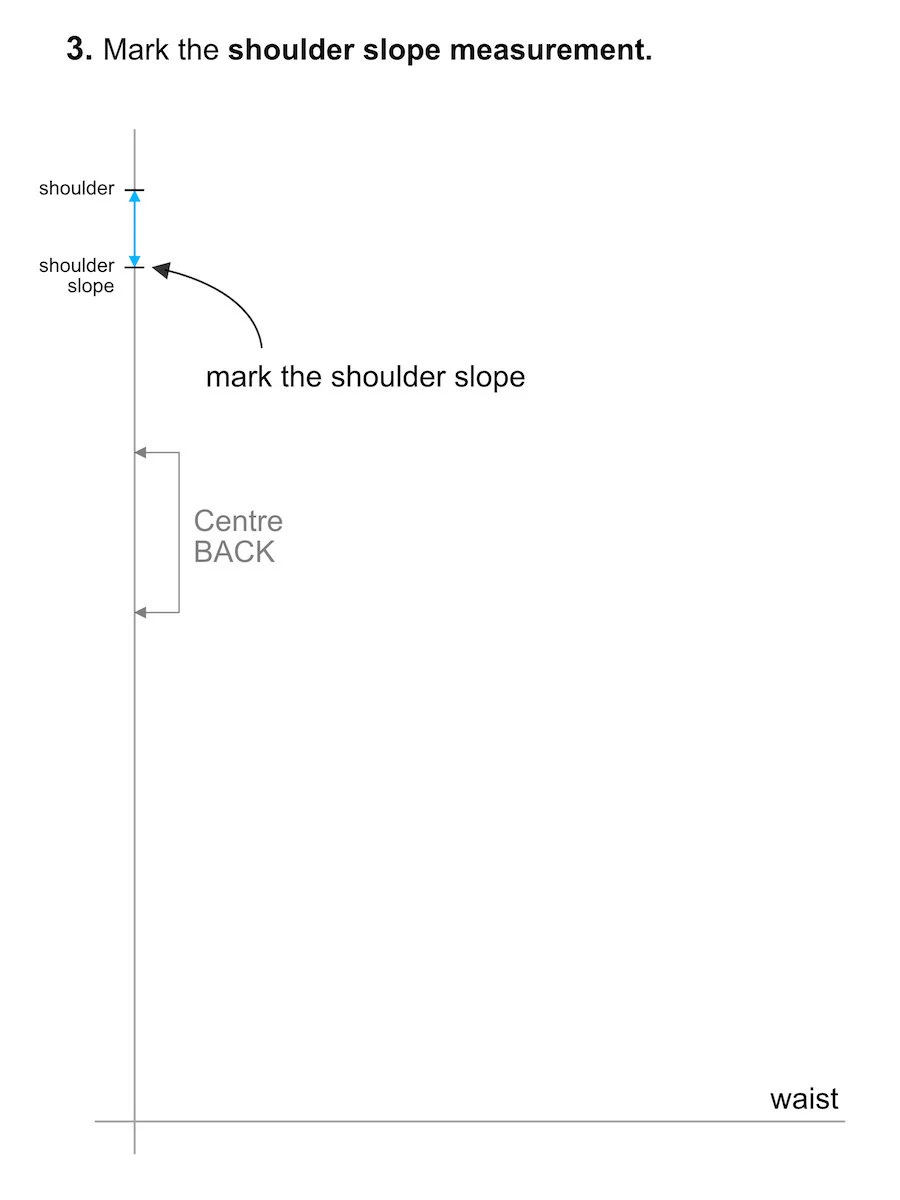
Marking the shoulder slope measurement on the vertical line.
b

Draw according to the following measurement:


b = shoulder slope

Marking the neck to waist length at back measurement on the vertical line of the basic bodice pattern.
c

Draw according to the following measurement:


c = neck to waist length at BACK

Marking the bust to waist length measurement on the vertical line.
d

Draw according to the following measurement:


d = bust to waist length

Marking calculated armscye centre length on the vertical line.
e

Draw according to the following formula:


e = (neck to waist length at BACK – bust to waist) / 3

————

neck to waist length at BACK =  

bust to waist = 
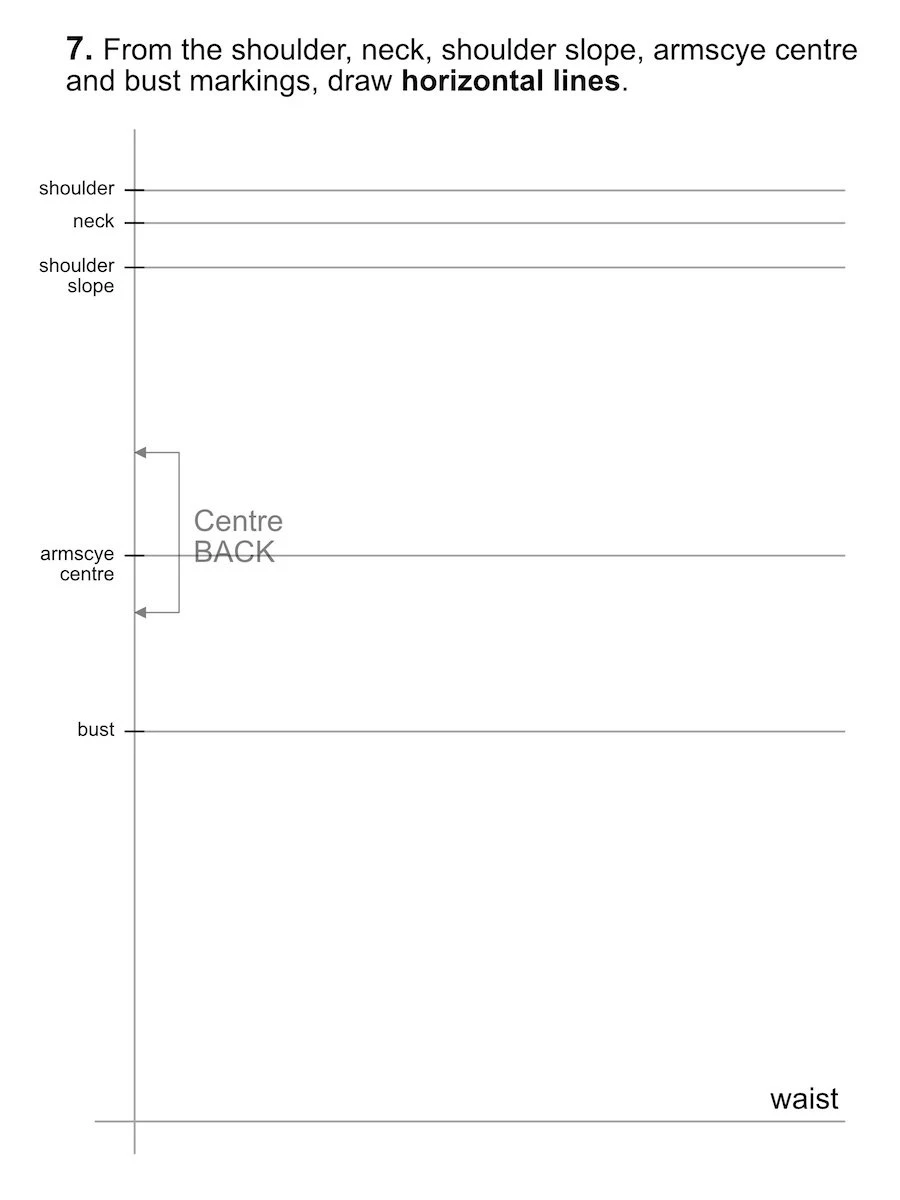
Drawing horizontal guidelines perpendicular to the vaertical line and originating from the previously drawn markings.
Drawing the centre back line of the bodice pattern.

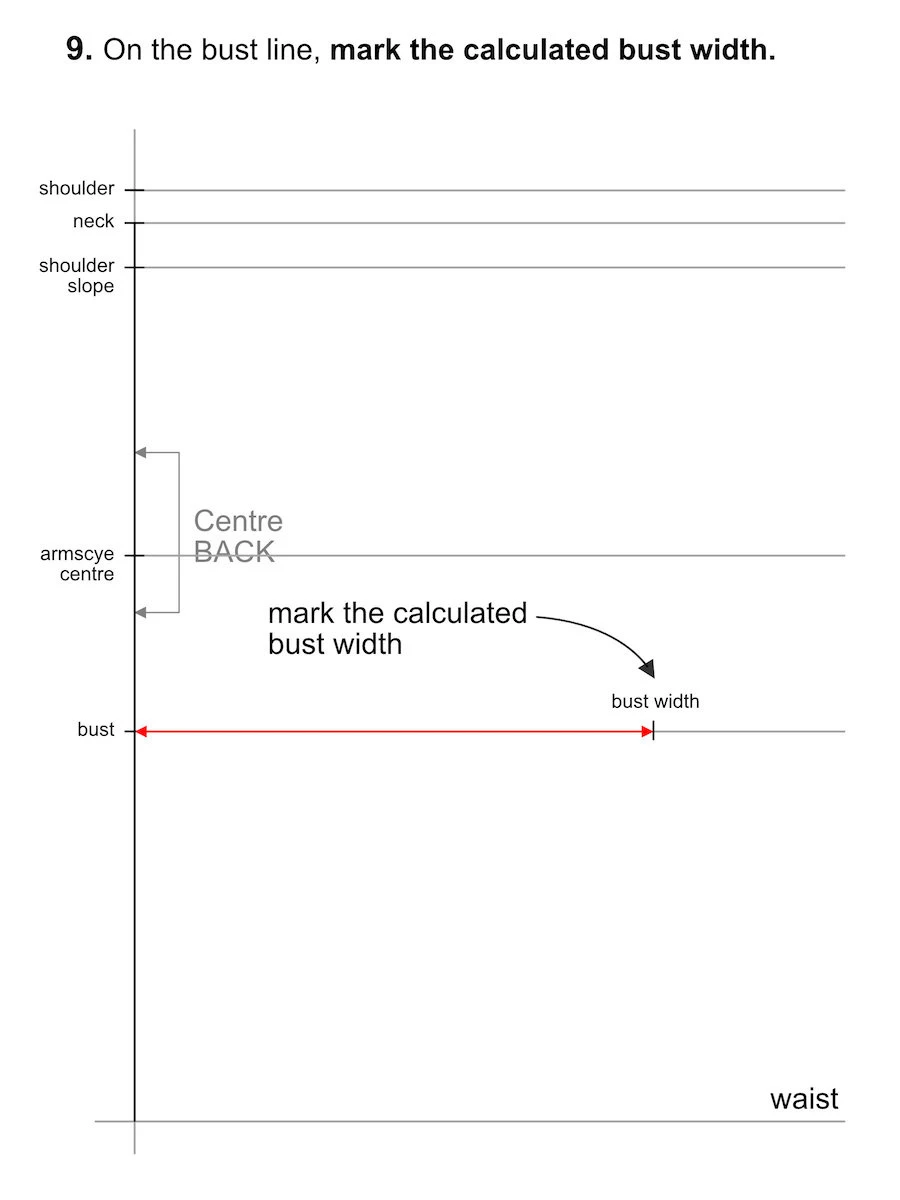
Marking the bust with ease width on a horizontal line.
f

Draw according to the following formula:


f = (bust circumference + ease)/ 4

————

bust circumference =  

bust ease =  


The circumference with added ease has to be divided by 4 as you are drafting 1/4 of the pattern (one-half of the BACK pattern piece).

Marking a dart point at the back pattern piece.
g

Draw according to the following formula:


g = bust divergence / 2

————

bust divergence =  


The vertical line drawn downwards from the dart point is the centre fold line of the future dart at the waist. It will cross the centre of the dart base you will draw in one of the following steps.


Marking the waist with on the bottom horizontal line.
h

Draw according to the following formula:


h = (waist circumference + ease) / 4 + dart width

= dart width = ((bust circumference + ease) – (waist circumference + ease)) / 8


The waist circumference with added ease has to be divided by 4 (again, because of drafting 1/4 of the whole bodice pattern). However, the dart width has to be added to this calculation, so that you can create a dart at the waist.


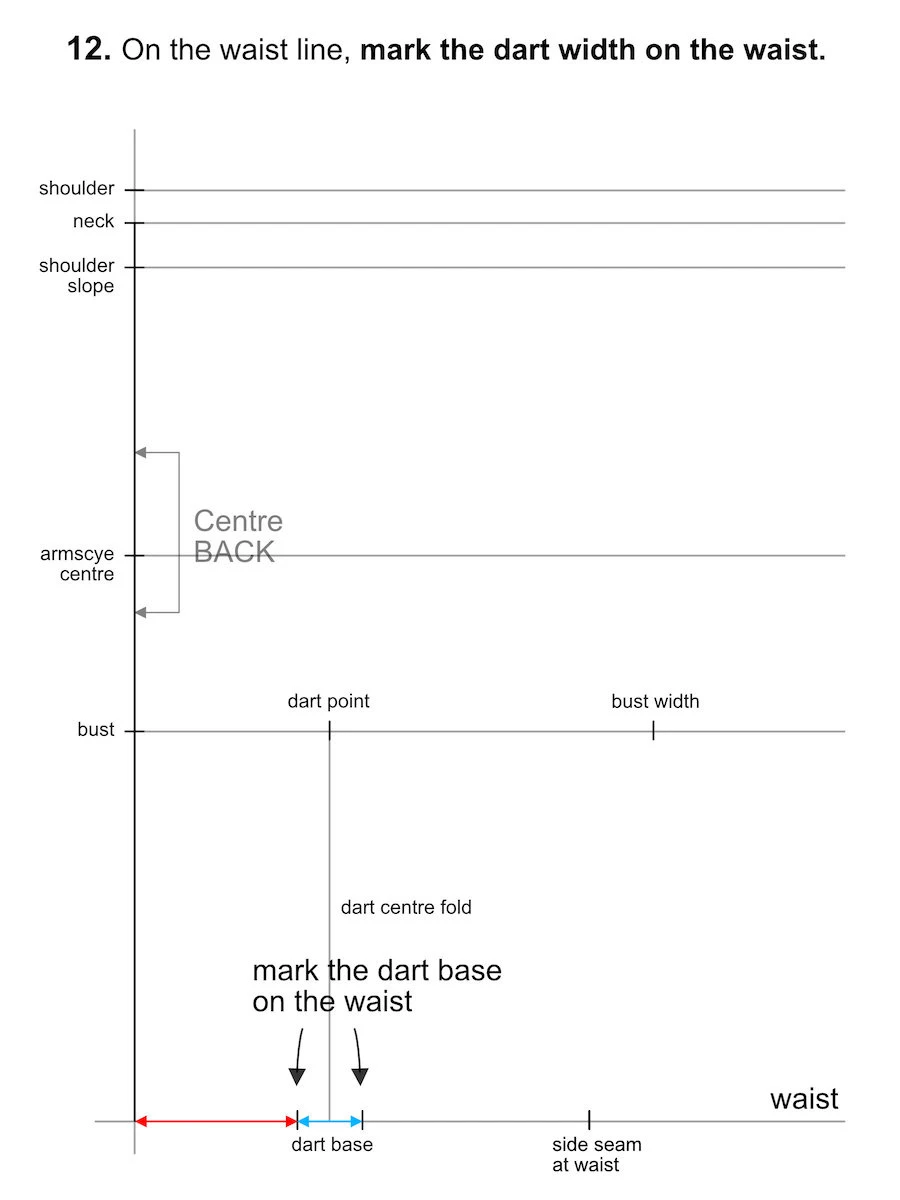
Drawing the base of the dart at the waist. he dart base centre is vertically aligned with the previously marked dart point.
j
i

Draw according to the following formula:


j = (bust divergence – dart width) / 2

——

bust divergence = 

i = dart width


Draw the dart base under the dart point. Make sure the vertical line crosses its centre. The measurement between the centre back and the dart base marking on the left should match the formula (bust divergence – dart width) / 2


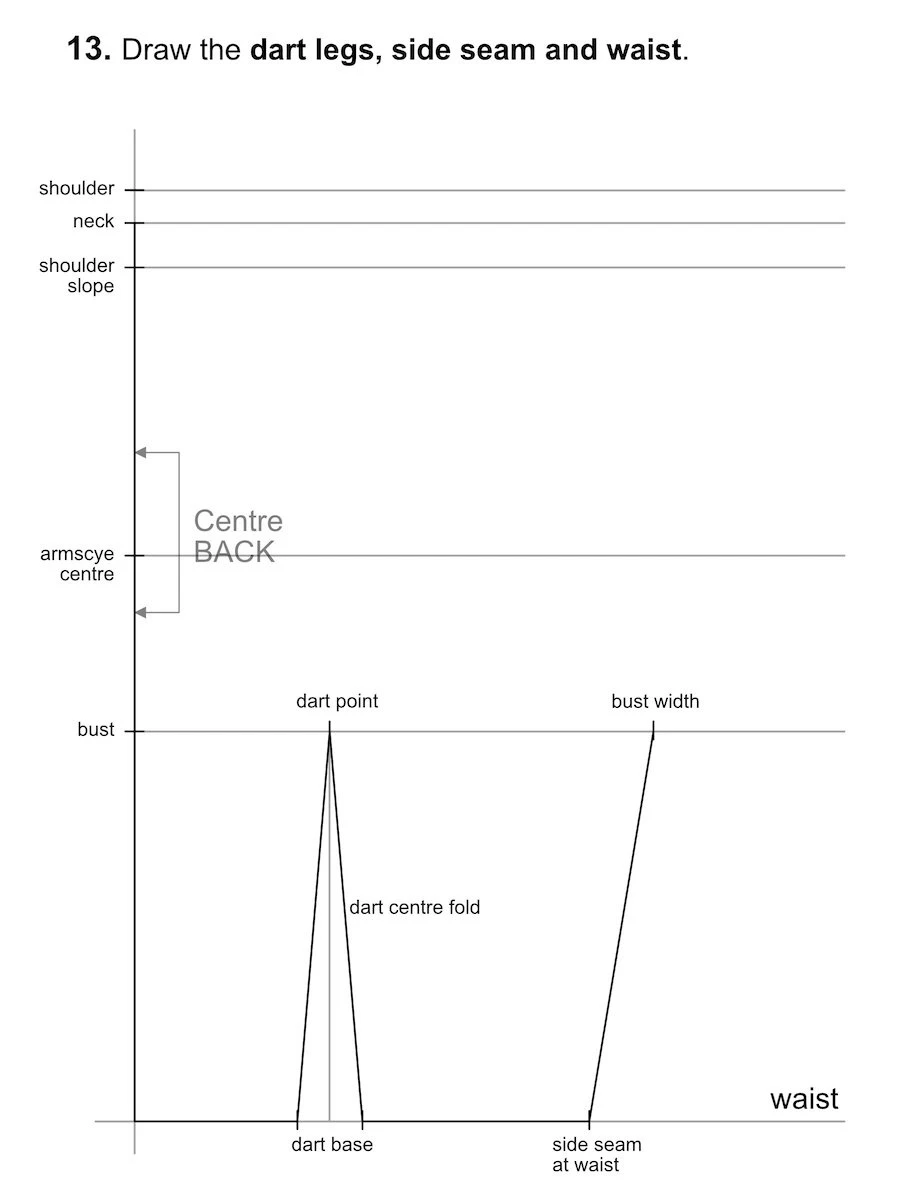
Drawing the side seam, waist and waist dart of the basic bodice back pattern piece.

Drawing the bust width for the pattern piece.
k

Draw according to the following formula:


k = armscye centre width at BACK / 2

——

armscye centre width BACK = 


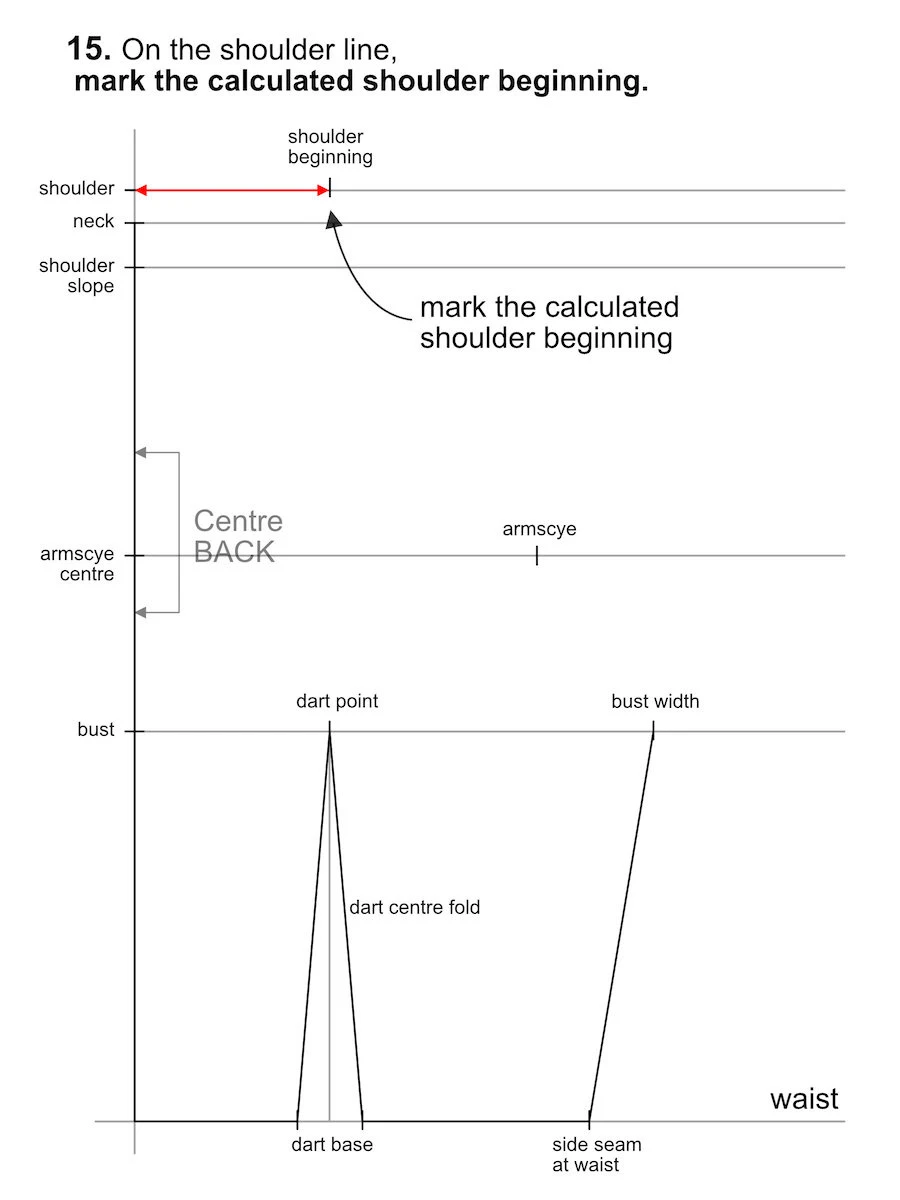
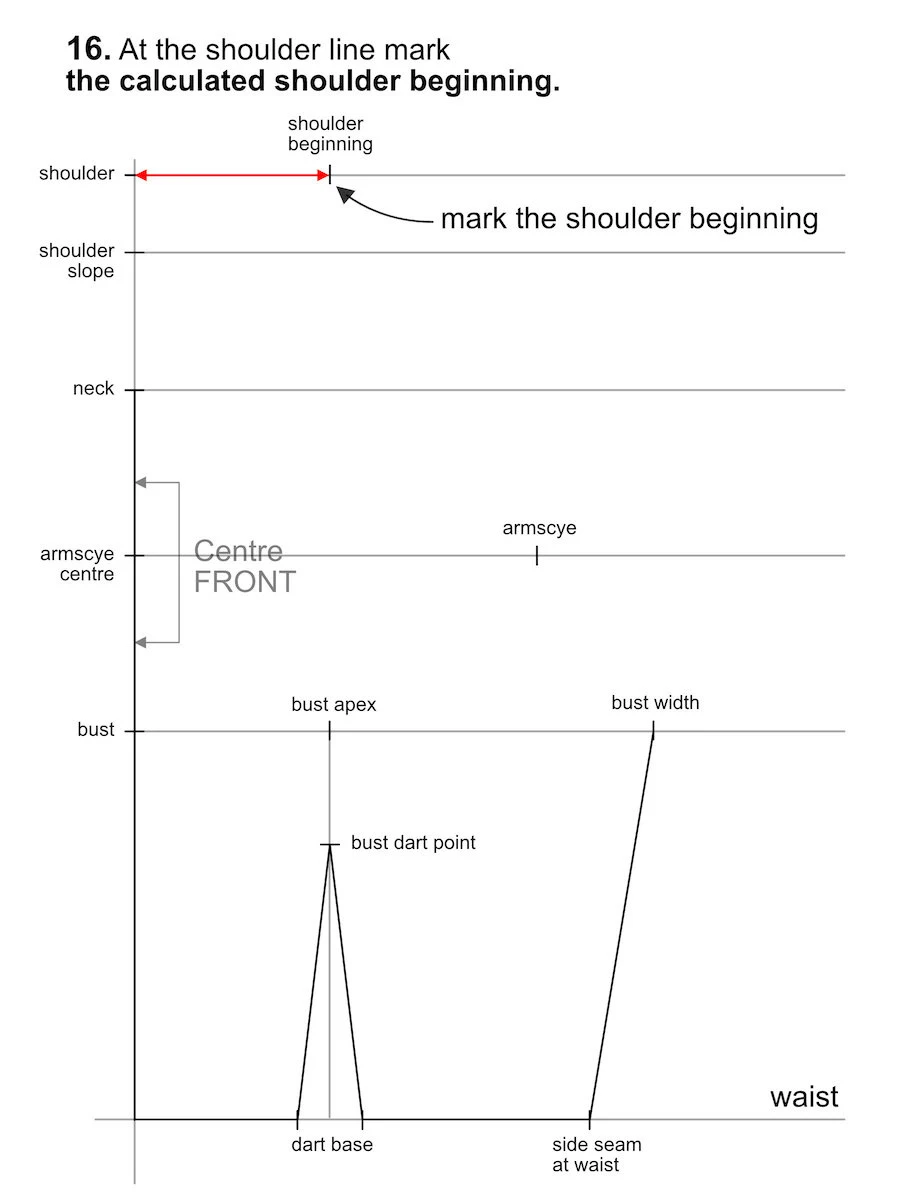
Marking the shoulder beginning.
l

Draw according to the following formula:


l = neck circumference / 6 + 2 cm (6/8”)

——

neck circumference = 


The first part of the formula (neck circumference / 6) computes the approximate radius of the neck. This means the centre of the pattern to the edge of the neck. However, the shoulder beginning is located a little further from the neck, therefore extra 2 cm (6/8”) need to be added.


Drawing a vertical line downwards from the shoulder beginning.
The vertical line drawn from the shoulder beginning will help you with drawing the neckline.

Drawing the neckline at the basic bodice BACK pattern piece.

Start at the shoulder beginning. First, draw a curved line and then draw along the horizontal neck line.


Drawing the shoulder of the basic bodice pattern.
m

Draw according to the following measurement:


m = shoulder length


Drawing the armscye of the basic bodice pattern.

Draw the armscye: start at the shoulder beginning, pass through the “armscye” marking and finish at the “bust width marking”.


The pattern is almost ready. Now, cut the BACK pattern piece from the fabric. Make sure there are no draglines along the back of the neckline or at the armscye. Moreover, that the centre BACK and the side seam hang nice and straight.


Folding a dart at the basic bodice pattern piece.

Fold a narrow dart at the armscye that points towards the centre BACK of the pattern. Pin this dart.


Outlining the folded dart at the basic bodice back pattern piece with a pencil.

Outline the dart legs with a pencil or marker.


Transferring the folded dart to the basic bodice BACK pattern.

Transfer the dart to the BACK pattern piece. At the BACK the dart is quite narrow and the dart legs the same length.


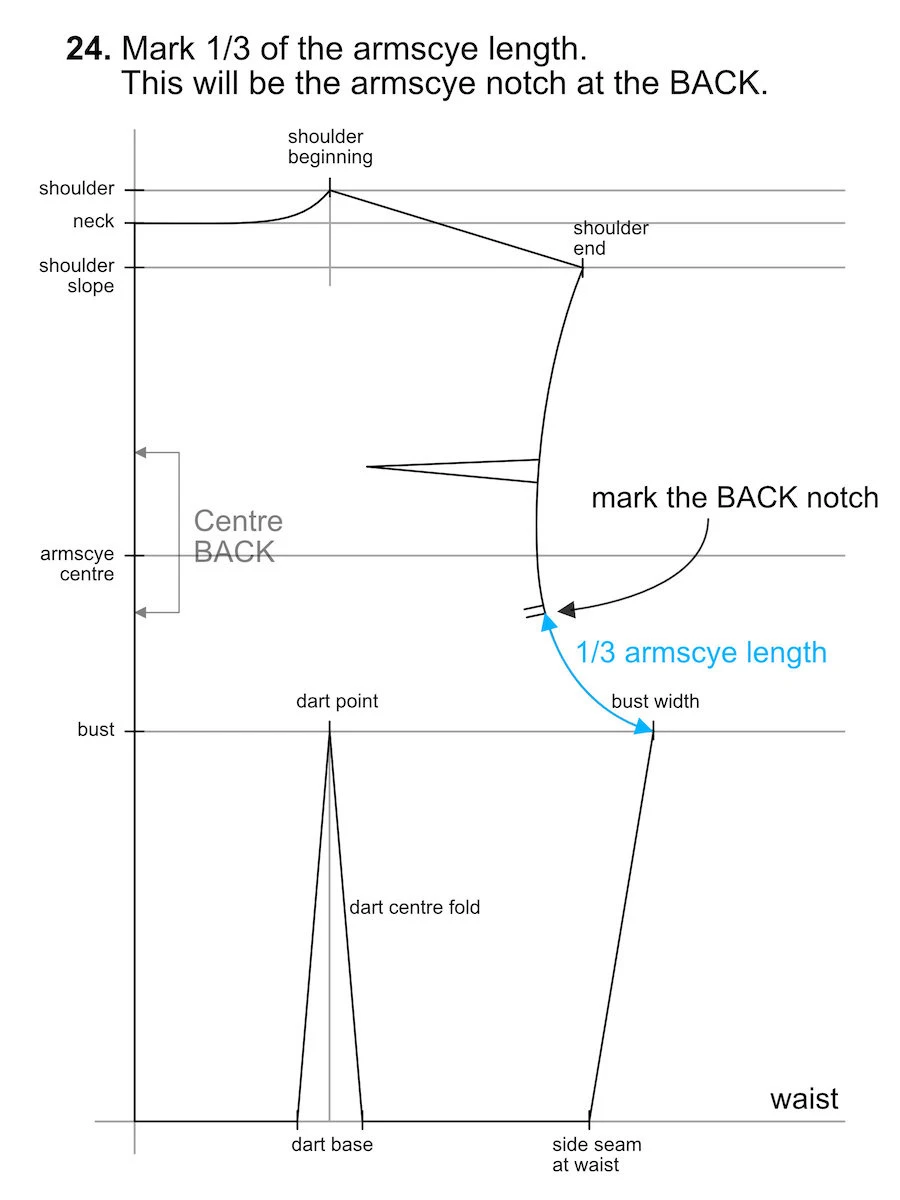
Measuring the length of the bodice armscye at the BACK.

Using a tape measure or a flexible ruler, measure the length of the bodice armscye. Do NOT include the dart in the measurement.


Mark the notch at the BACK of the bodice.

Calculate 1/3 of the measured armscye length and mark this distance on the armscye with two small strokes. This will be the notch a the BACK for sewing the set-in sleeve.


The basic bodice block pattern BACK is finished.

Your basic bodice block BACK pattern piece is ready.


How to draft the basic bodice block – FRONT pattern piece

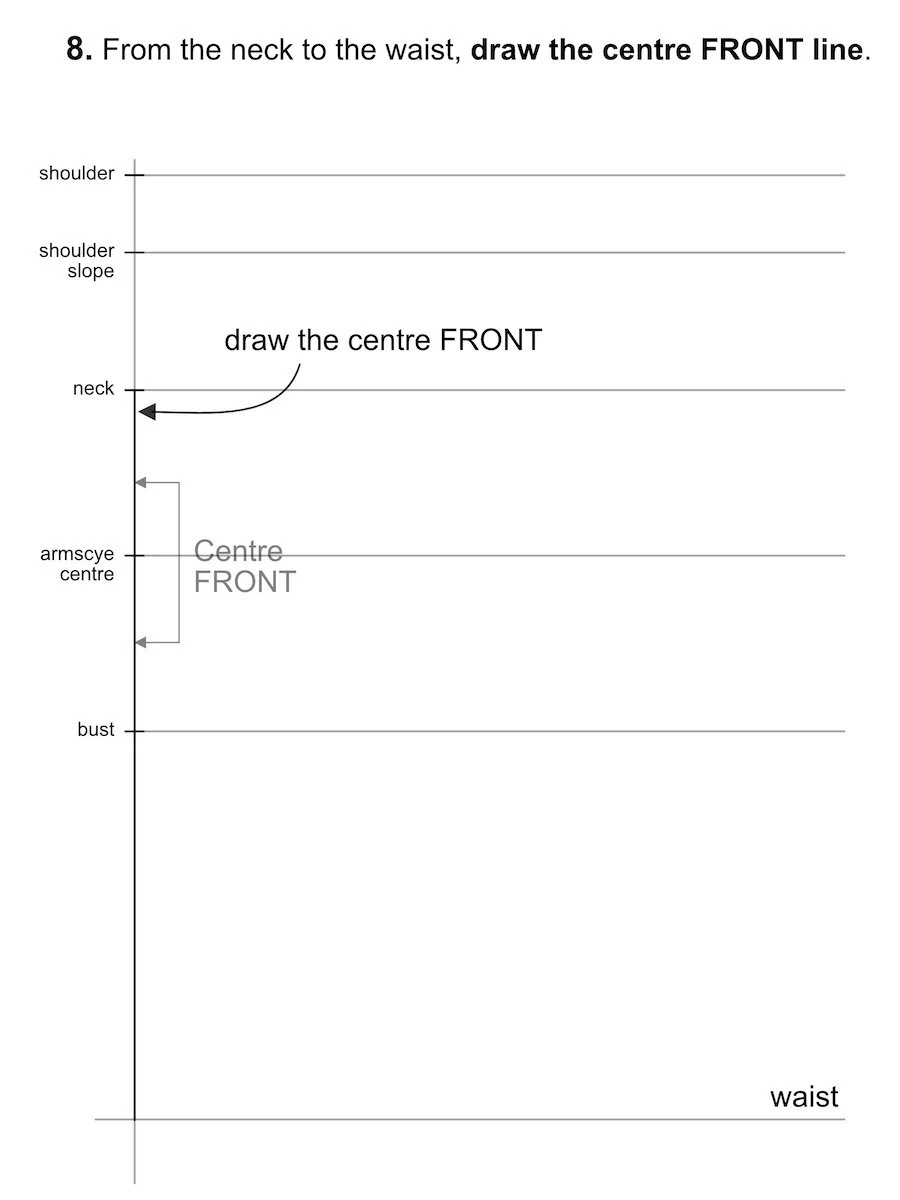
The steps and formulas for the FRONT part of the bodice will be similar to the ones you have followed to draw the BACK pattern piece.

Drawing two perpendicular lines that will be the centre FRONT and waist line of the basic bodice pattern FRONT.

On a large sheet of paper, draw two perpendicular lines. The vertical one will be the centre FRONT and the horizontal one the waistline.


Marking the shoulder to waist length at FRONT measurement on the vertical line.
a

Draw according to the following measurement:


a = shoulder to waist length at FRONT


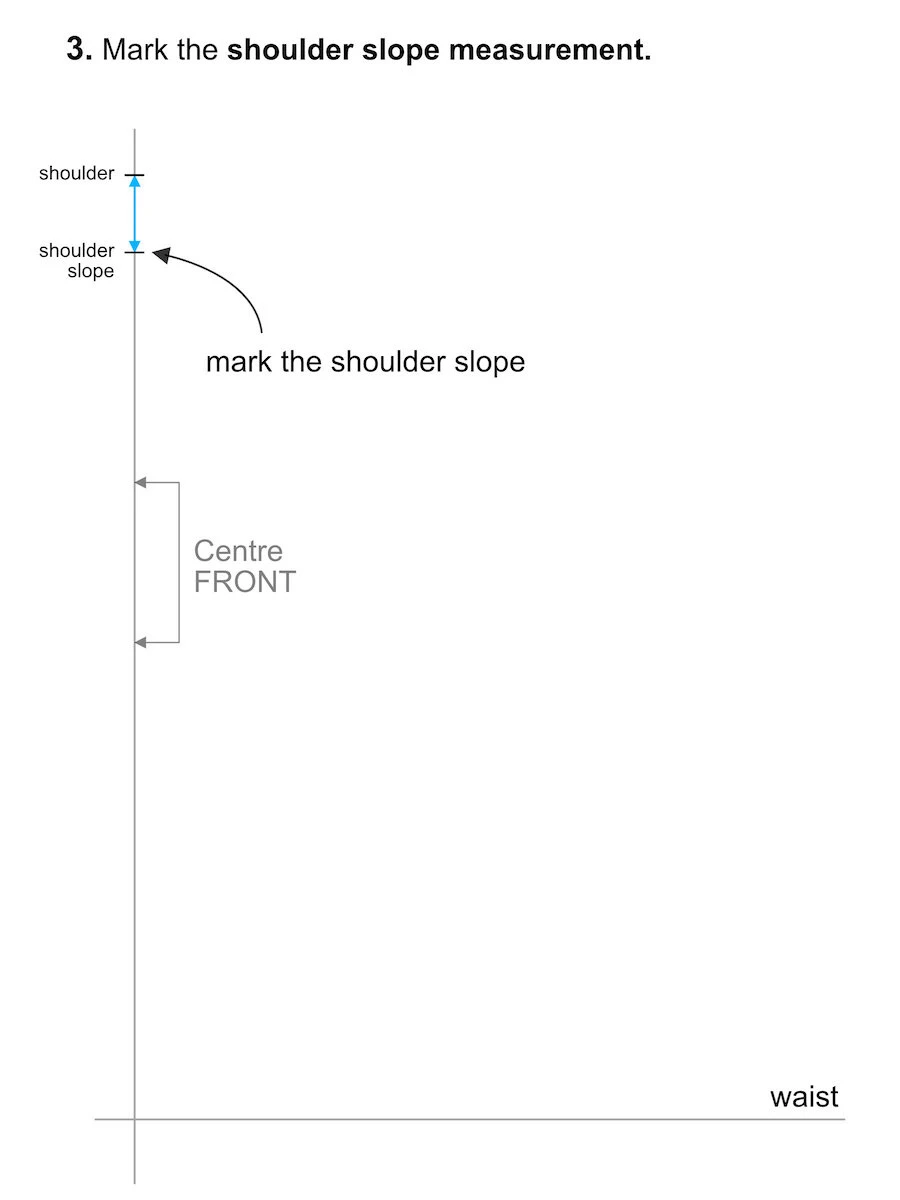
Marking the shoulder slope measurement on the basic bodice vertical line.
b

Draw according to the following measurement:


b = shoulder slope


Marking the neck to waist length at FRONT measurement on the vertical line.
c

Draw according to the following measurement:


c = neck to waist length at FRONT


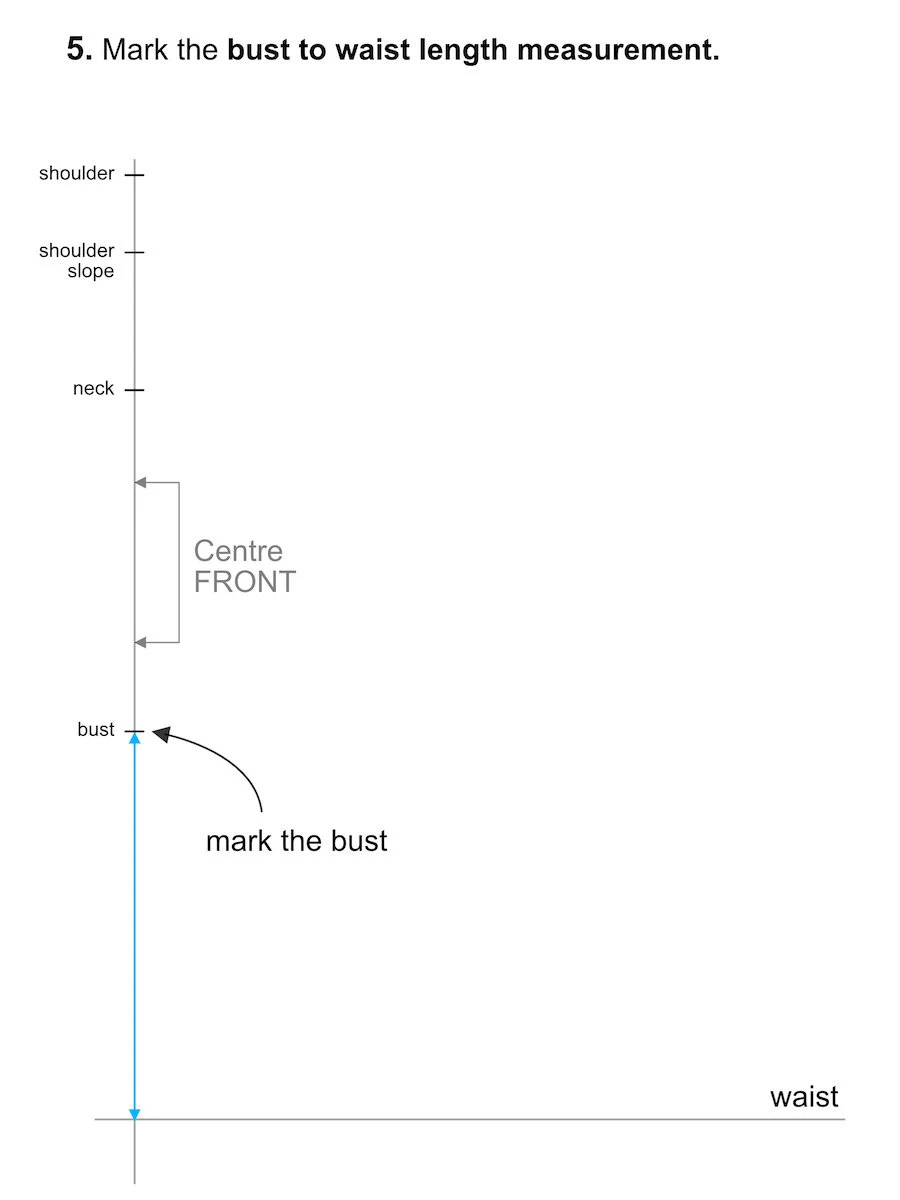
Marking the bust to waist length measurement.
d

Draw according to the following measurement:


d = bust to waist length


Marking the calculated armscye centre length on the basic bodice.
e

Draw according to the following formula:


e = (neck to waist length at BACK – bust to waist) / 3

————

neck to waist length at BACK =  

bust to waist = 
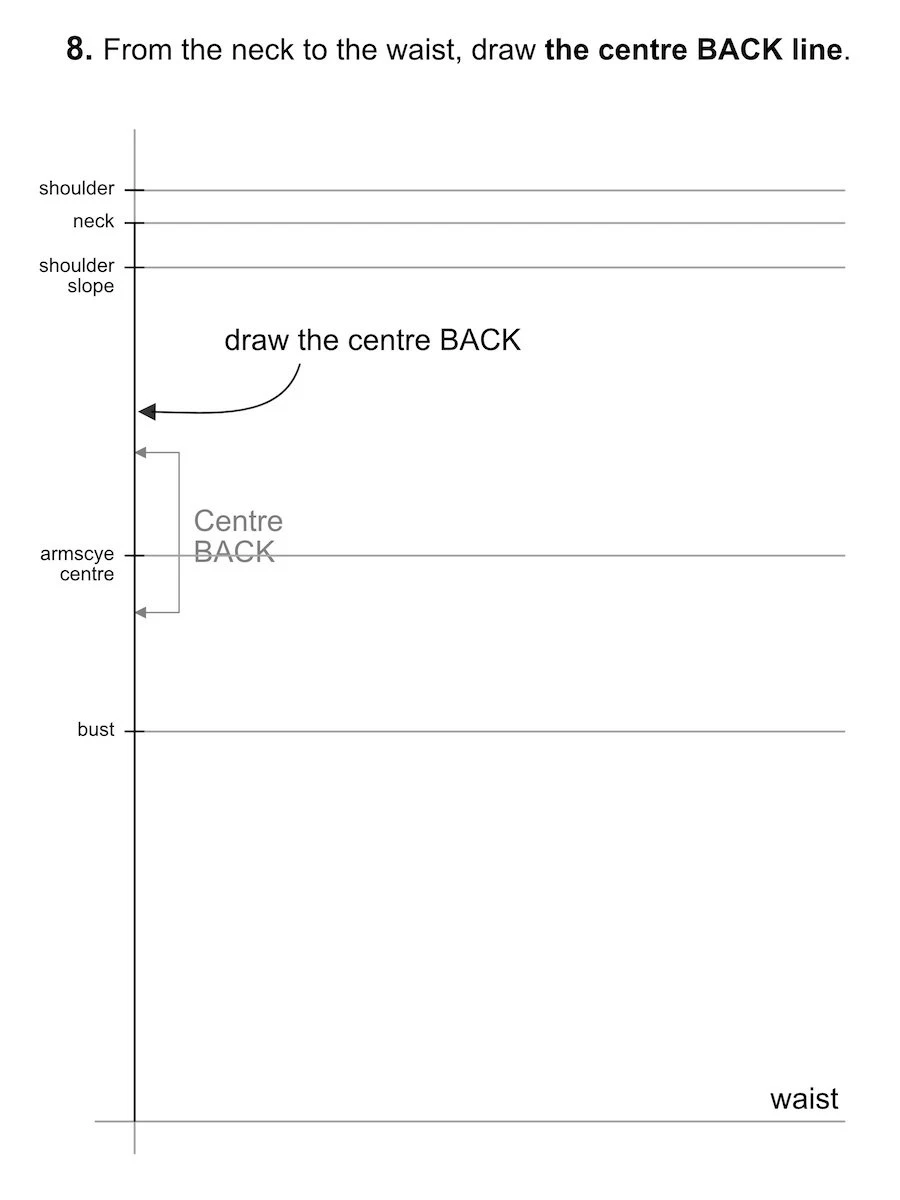

This calculated measurement is the same as on the BACK pattern piece.

Drawing horizontal lines originating from the previously drawn markings.

Drawing a rectangle based on personal body measurements that is a base of a basic skirt sloper.

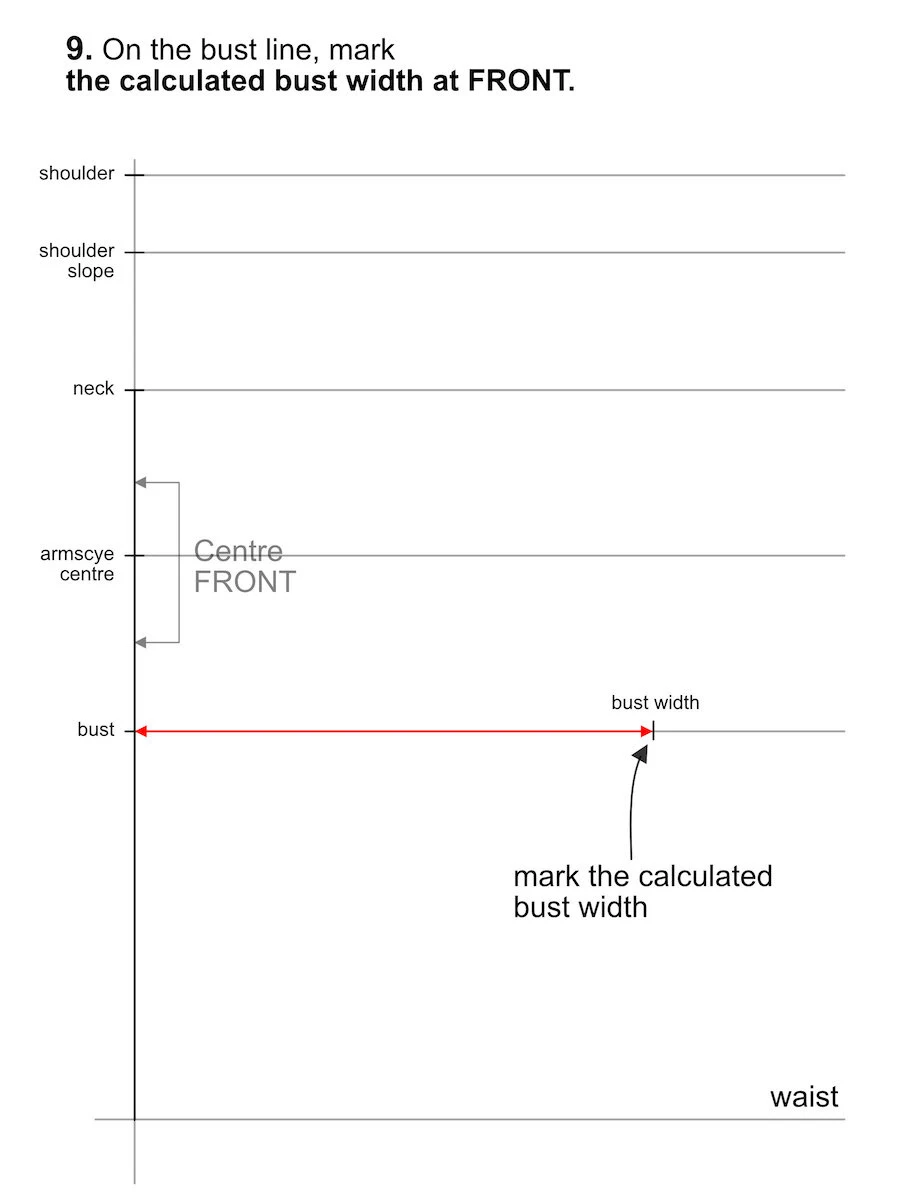
Marking the bust width according to the provided formula.
f

Draw according to the following formula:


f = (bust circumference + ease)/ 4

————

bust circumference =  

bust ease =  


Again, the bust circumference with ease has to be divided by 4 in order to draft one half of the FRONT pattern piece.

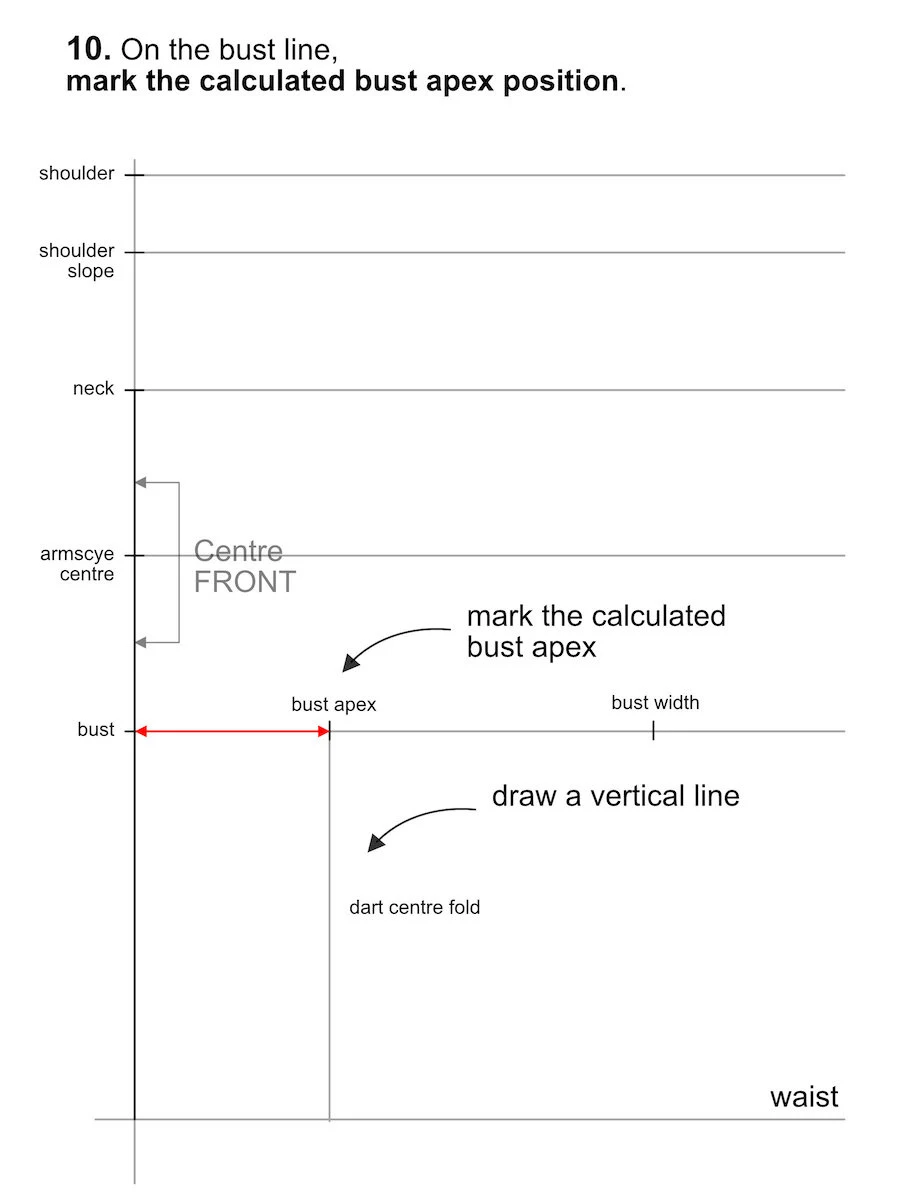
Marking the bust apex of the basic bodice.
g

Draw according to the following formula:


g = bust divergence / 2

————

bust divergence =  


The distance between the centre FRONT and the bust apex is the same as the distance between the centre BACK and the dart point.

Marking the waist of the basic bodice front pattern piece according to the provided formula.
h

Draw according to the following formula:


h = (waist circumference + ease) / 4 + dart width

= dart width = ((bust circumference + ease) – (waist circumference + ease)) / 8


The circumference with added ease has to be divided by 4 in order to gain measurement for 1/4 of the pattern. The dart width has to added, otherwise you won’t be able to create a dart at the waist.
The waist width of the FRONT pattern piece is the same as the waist width of the BACK pattern piece.

Drawing the base of the dart at the waist. he dart base centre is vertically aligned with the previously marked dart point.
j
i

Draw according to the following formula:


j = (bust divergence – dart width) / 2

——

bust divergence =  

i = dart width


Draw the dart base under the dart point. Make sure the vertical line crosses its centre. The measurement between the centre back and the dart base marking on the left should match the formula (bust divergence – dart width) / 2.


Marking the distance between the bust apex and dart point.
k

Draw according to the following measurement:


k = dart point = 4 cm (1 1/2”)


The bust dart point has to be placed below the bust apex. It should never be positioned directly on the bust apex, thus creating an unpleasant design.

Drawing the waist, waist dart and side seam of the basic bodice front pattern.

Drawing the armscye centre width at the front of the basic bodice.
l

Draw according to the following formula:


l = armscye centre width at FRONT / 2

——

armscye centre width FRONT = 


Marking the calculated shoulder beginning at the baisc bodice front pattern.
m

Draw according to the following formula:


m = neck circumference / 6 + 2 cm (6/8”)

——

neck circumference = 


The formula above is the very same as for the BACK pattern piece.

Drawing a vertical line from the marked shoulder beginning.
The vertical line drwan from the shoulder beginning will help you with drawing the neckline.

Drawing the neckline of the basic bodice front pattern.

Start at the shoulder baginning. First, draw along the vertical line and then move towards the neckline marking.


Drawing the shoulder of the basic bodice pattern.
n

Draw according to the following measurement:


n = shoulder length


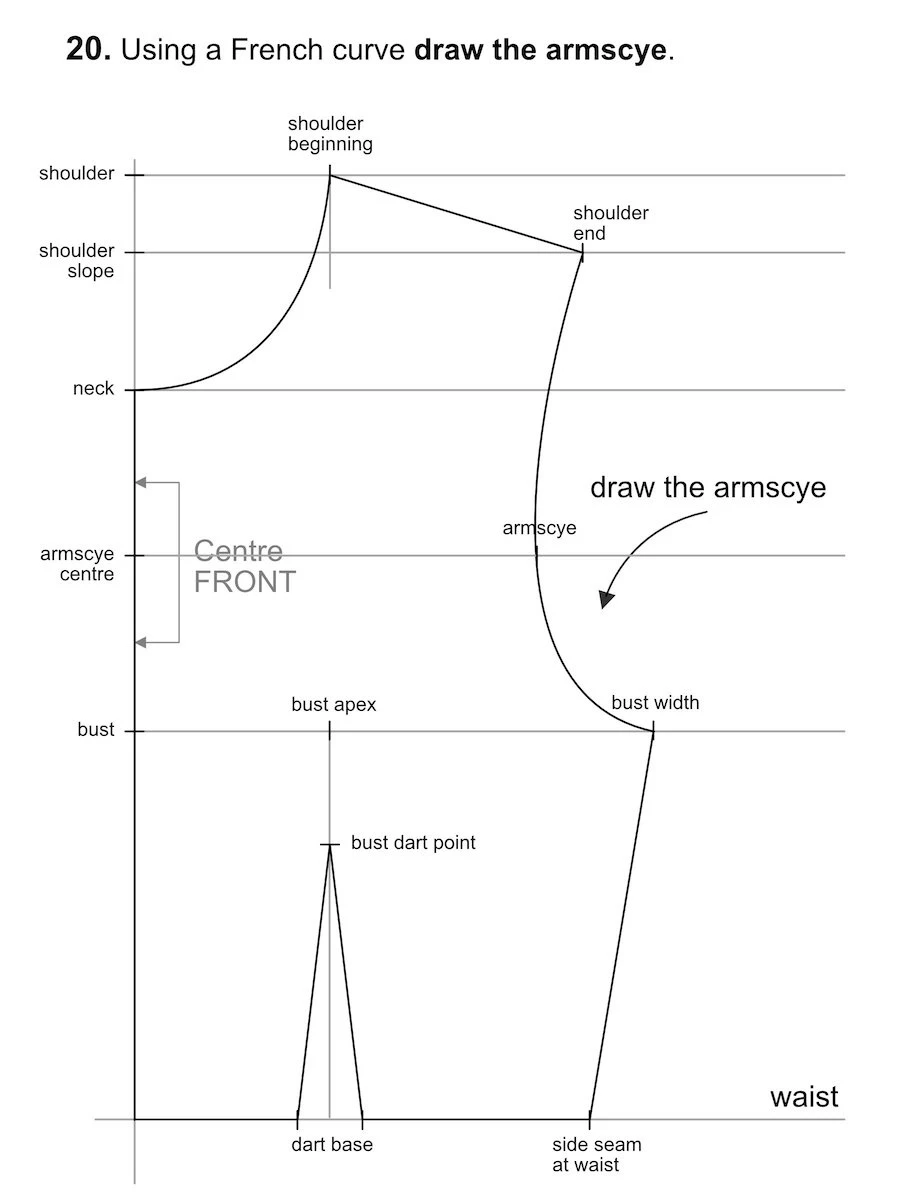
Drawing the armscye of the basice bodice front patten piece.

Draw the armscye: start at the shoulder begining, pass through the “armscye” marking and finish at the “bust width marking”.


The pattern is almost ready. Now, cut the FRONT pattern piece from the fabric. Make sure there are no draglines on the bust. Further, the dart points towards the bust apex (but ends below the apex). And, that the centre FRONT and the side seam hang straight.


Folding a dart at the armscye that points towards the bust apex.

Fold and in a dart at the arsmcye. The legs of the dart should direct towards the bust apex. Pin this dart.


Outlining the legs of the dart at the basic bodice.

Mark the dart legs with a pencil or a marker so that you can visibly see them after you unfold the dart.


Transferring the dart legs to the pattern.

Transfer the dart from the bodice to your pattern.


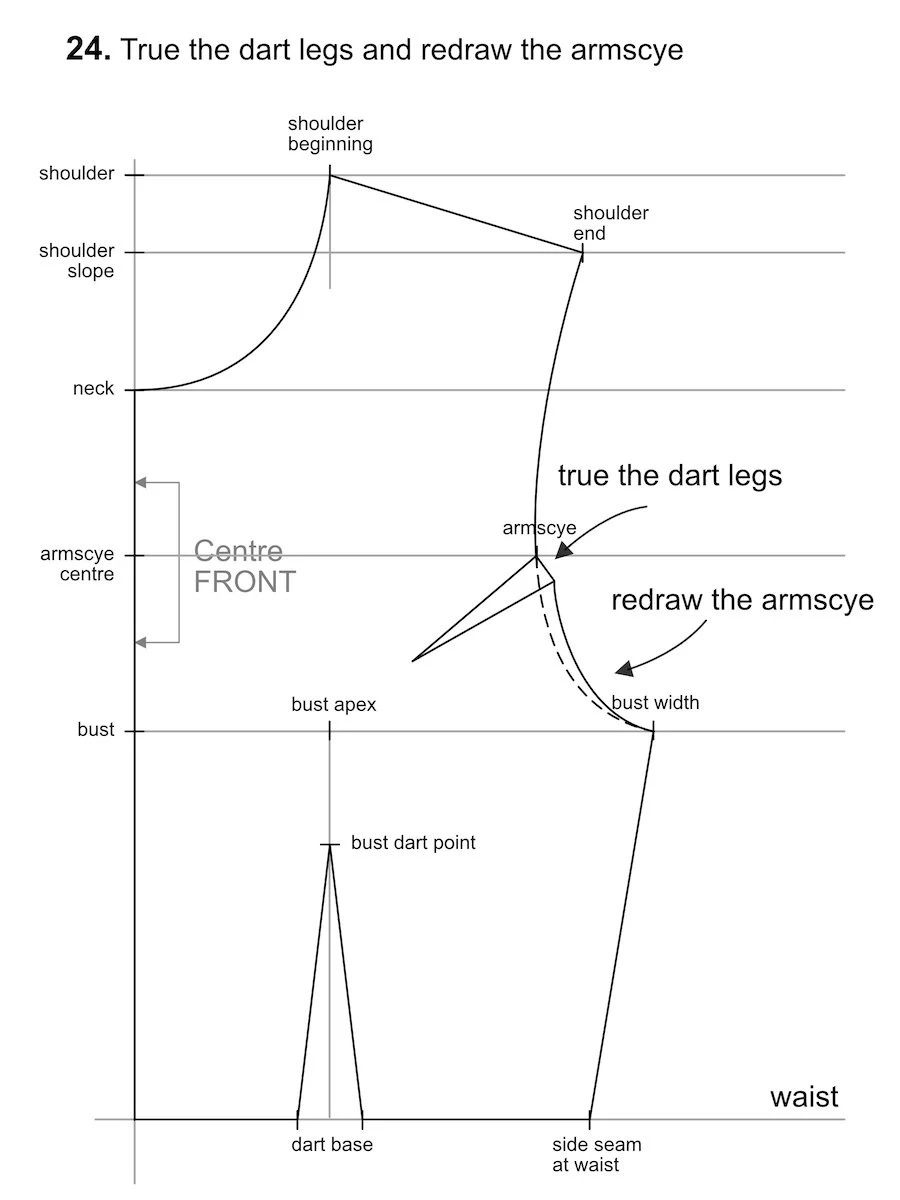
Truing the darts and redrawing the lower part o the armscye.

Now, you need to true the dart legs. That means making both dart legs equally long. Prolong the shorter (bottom) leg of the dart. Make sure it is as long as the upper one and redraw the lower part of the armscye. The black dotted line on the left shows the original shape of the armscye.


Measuring the armscye.

Using a tape measure or flexible ruler, measure the length of the armscye. Do NOT include the dart in the measurement.

Measuring the armscye.

Calculate 1/3 of the measured armscye length and mark this distance on the armscye with two small strokes. This will be the notch a the BACK for sewing the set-in sleeve.


The basic bodice block drafted according to the previous steps is finished.

Your basic bodice block pattern is ready.


How did you like this post?

Click on a star to rate it!

Average rating 4.9 / 5. Vote count: 105

No votes so far! Be the first to rate this post.

We are sorry that this post was not useful for you!

Let us improve this post!

Tell us how we can improve this post?

Working with the basic sloper

If you are just beginning with making your own sewing patterns, you might find the following publication by Adele P. Margolis useful. It will teach you how to alternate basic blocks to make your own designs (click here to read my review). This way you can turn your very simple looking basic bodice into an interesting fashion piece.

Conclusion: How to draft a bodice block

Drafting a basic bodice sloper might look a little complicated and overwhelming at first sight. Especially if you have to take so many different body measurements. However, if you take them correctly, drafting the pattern slowly, in a step-by-step manner, will lead you to the desired result: a nice fitted bodice.

Now, that your bodice pattern is finished, you can move to the next step: drafting a sleeve for the bodice. You will find detailed instructions in this tutorial.

Basic bodice block drafting FAQs

This custom-fit bodice pattern is designed for beginners. The interactive tutorial guides you through each step, transforming confusion into confidence with clear instructions and precise measurement calculations, helping you create a professional pattern even if you’re new to drafting.
Select stable woven fabrics like cotton or cotton blends for your basic bodice block. These beginner-friendly fabrics prevent distortion and ensure a precise fit. Avoid stretchy or slippery materials like knits or satin until you’re confident, allowing you to draft with ease and achieve a smooth result.
Fabric needs vary based on your measurements. For most adults, a side-by-side layout (pattern pieces placed horizontally) requires 40–80 inches in width × 14–20 inches in length (100–200 cm width × 35–50 cm length), while a stacked layout (pieces placed vertically) needs 20–40 inches in width × 28–40 inches in height (50–100 cm width × 70–100 cm height). Use the interactive tool for a precise estimate, ensuring a seamless drafting process.
Accurate measurements are essential for a custom-fit bodice, and the process is straightforward. You’ll need a tape measure, elastic band, pen, and optionally our bodice measurements cheat sheet. Place an elastic around your natural waist (narrowest part of your torso) and measure:
  • Measure your bust circumference at the fullest part.
  • Measure bust divergence (distance between bust apexes).
  • Measure from a bust apex to the elastic band placed at your natural waist.
  • Measure your neck circumference at the base of your neck.
  • Measure the neck to waist length at the front. Start at the top of the breastbone, across the fullest part of the bust, to the natural waist.
  • Measure from the beginning of your shoulder down to the elastic band at your natural waist.
  • Measure the shoulder length from the shoulder beginning to the end of the shoulder.
  • Measure the shoulder slope: the vertical difference between your shoulder beginning and shoulder end.
  • Measure the armscye centre width at the front, above the armpits.
  • Measure the neck to waist length at the back. Start at the most prominent vertebra of your neck and measure to the elastic band at your natural waist.
  • Measure from the beginning of your shoulder down to the elastic band at your natural waist at the back.
  • Measure the armscye centre width at the back, above the armpits.
To draft your custom bodice pattern, gather a large sheet of paper or tissue paper, a pencil (for guidelines), a Sharpie or pen (for final lines), a long ruler, and a French curve or flexible curve ruler (for curves). These accessible tools, combined with the interactive tutorial, turn your measurements into a professional pattern with ease.
Stretch woven fabrics are suitable for a snug, custom-fit bodice. Their slight give allows less ease at the waist and bust, creating a tailored look using the same drafting method. This approach helps you craft a pattern with confidence and a comfortable fit.
This bodice pattern is designed for woven fabrics, not knits, due to their distinct stretch and need for zero or negative ease.
The bodice tutorial is a digital PDF, providing instant access to begin drafting your custom-fit design. Use the free interactive tutorial to download it. This format allows you to start creating at your own pace without delays.
If you decide to purchase the PDF tutorial, you’ll receive a payment confirmation email with your receipt. The custom bodice pattern PDF is available for immediate download after purchase, allowing you to start crafting your perfect fit without waiting.
The interactive tutorial simplifies pattern drafting by calculating your all necessary measurements for the basic pattern and provides step-by-step illustrations. Just enter your body measurements, and it guides you through drafting a custom-fit bodice pattern—without any calculation mistakes.
The custom-fit bodice block is a valuable investment, providing a reusable pattern tailored to your body that saves time and money on future designs. Paired with the interactive tutorial, it helps you overcome drafting challenges, building lasting skills and confidence.

Processing…
You have successfully subscribed to anicka.design.

3 thoughts on “How To Draft A Basic Bodice Block Pattern?

Leave a Reply