Get your custom circle skirt pattern or tutorial with this calculator. Enter your measurements and get a PDF, NO MATH IS NEEDED.
🏷️ Regular price $7.99 starting on 27 February. Download your custom-fit PDF pattern now for the $4.99 launch price.


What do you get after you use the circle skirt calculator?
Online tutorial
FREE
✓ Step-by-step drafting illustrations
✓ Custom-fit drafting dimensions
✓ Fabric consumption
PDF tutorial
$FREE
✓ Step-by-step drafting illustrations
✓ Custom-fit drafting dimensions
✓ Formulas for calculated values
✓ Your measurements overview
✓ Fabric consumption
✓ Printable angle template
* Full-scale PDF pattern
$4.99
✓ Full-scale custom-fit circle skirt sewing pattern for home print
✓ 2 straight waistband options
✓ Link to online sewing instructions
✓ Easy page assembly layout
✓ Your measurements overview
✓ Fabric consumption
✓ Printer settings for best results
*currently available for all circe skirts except the DOUBLE circle skirt

Approximate fabric consumption
🧵Get your complete collection of 6 circle skirt patterns. All custom-fit in 1 PDF. 🧵
How to draft the circle skirt pattern
In the images below you can see simple instructions on how to draw the life-size pattern. For more a detailed drafting description, please follow this post. In this blog post, you can learn more about the underlying math and construction principles.
Keep in mind, that you are going to draw one half of the FRONT/BACK pattern piece. Make sure that you: transfer the pattern twice. Place the pattern on fabric fold.
-
First, draw a long line near the bottom of a large paper. This will be the centre FRONT/BACK of the circle skirt pattern, label it. Mark a point C on its left side. You will use it to draw the waist and the hem of the skirt (see the image below).

-
From point C measure two distances: Radius at waist and Radius at hem based on the results from the circle skirt pattern calculator above (see the image below).
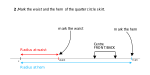
-
Using a protractor or this template, draw a long line under the corresponding angle for the selected circle skirt. This line will be its side side seam.
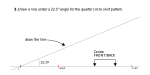
-
Using a pair of compasses or string and pencil, draw the skirt waist and hem. Redraw the waist and hem with a Sharpie (see the image below).
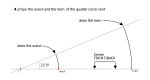
-
Using a long ruler and a Sharpie, draw the side seam and Centre FRONT/BACK line. Both of these will start at the waist and end at the hem of the skirt pattern.(see the image below).
Using a long ruler and a Sharpie, draw the side seams of the panel. Both of them will start at the waist and end at the hem of the skirt pattern.(see the image below).
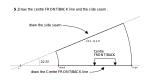
-
To mark the grainline, fold the pattern in half. You will find the grainline on the fold (see the image below).
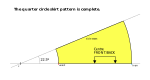
Once your pattern is ready, it’s time to cut the fabric.
Conclusion
As you can see, drafting a circle skirt pattern is quite easy even for a sewing beginner. Just use cotton or linen fabric and make a comfortable summer skirt and add a nice DIY garment to your wardrobe. Also, don’t forget about proper equipment that will make your sewing easier.
To hem a circle skirt of any type, you can use a bias binding tape (use ready bias binding tapes or make your own using a bias tape maker). As decoration, you can add gathers or flounces to the hem.
If you wish to learn more about the construction behind the individual circle skirt pattern types in detail, read my blog post.
Cricle skirt calculator FAQs
- Quarter-circle skirt
- Half-circle skirt
- Three-quarter circle skirt
- Full-circle skirt
- One-and-half circle skirt
- Double circle skirt
- Scaled to your measurements
- Formatted for home printing: Letter size or A4 international
- Ready to print, cut and assemble
- Assembly overview for accurate assembly
- Recommended printer settings
- Approximate fabric consumption that takes seam and hem allowance into account
Hi Anicka!
I used this calculator quite often before but now it doesn’t calculate anymore and also the download doesn’t work! 🙃
Thank you!
Madelaine
Hi Madelaine, thank you for the info. I will look into it immediately.
Anicka
hi! everytime i’ve tried to calculate a double circle skirt pattern and download the pdf it has created an error? it worked for all other options, just not that one?
Hi Dovie,
thank you for letting me know. I will definitely look into it. As soon as I fix this issue, I’ll let you know.
Anicka
Hi Dovie,
I have already fixed the issue. Again, thank you for letting me know. Have a nice summer.
Anicka
I love this calculator and use it for all my circle skirts! Do you have any idea when the PDF tutorial will be up and running again?
Hello Ilse,
thank you for your lovely comment! The download should be working already. But if it doesn’t work for you, try emptying/deleting your browser cache. If you need any assistance with that, just let me know.
Anicka
Thanks for such an easy and comprehensive calculator. I’m planning to get a round tablecloth and turn it into a skirt!
Hi, thank you for your lovely comment. I hope the big change from a tablecloth to a skirt will turn out well :)!
Have a nice day.
Anicka
This tool is wonderful and I’ve used it to make skirts for a wide variety of body types and sizes. Quick question…I have a downloaded file of the calculator output from a previous project, but now I can’t figure out how to download it again for a new project. Is it still possible to download the output from this calculator?
Hi Rebecca,
thanks for the comment and question. Yes, it is possible to download the pdf again. Every time you calculate the dimensions for a pattern by clicking the Calculate button, the Download button appears, and you can download the document again. There is only one exception with the Download button – it is not currently available for circle skirts drafted from 3 or more panels. However, I’m working on it!
If you have any further questions or you are having problems with downloading the documents, please feel free to contact me again 🙂
Anicka
Hi and thank you for the calculator!
I am trying to make this for the first time and I was wondering, the mesurments for each panels don’t contain the seams/ hems allowances? So if I transfer on my paper or fabric, I still need to put an extra more cm/ inch for that?
Hi Celine,
yes, you have to add the seam and hem allowances to your pattern before cutting it from the fabric. I included the seam and hem allowance in the calculator to approximate fabric consumption.
Anicka
The BEST circle skirt calculator. Question – if the fabric width or fabric pattern does not lend itself to drafting the full patterns like here – what is the best way to panel out a circle skirt? The gathered skirt tutorial seems similar but I wouldn’t want it gathered – just a normal circle skirt waist.
TYSM!
Hi Ayden, thank you for your lovely comment.
If the circle skirt pattern cannot fit into the fabric, you can: adjust the skirt length or divide the FRONT/BACK pattern piece into two pieces. However, that will result in additional side seams (4 side seams altogether). You can easily draft the divided pattern by following the instructions below the calculator. The side seam will be the side seam, and the Centre FRONT/BACK will be another side seam. Draw the pattern on a piece of paper and try to fit the 4 pattern pieces onto your fabric.
Btw: currently, I’m improving the calculator so that it will work similarly to the one in the gathered circle skirt calculator. However, it will take me some time.
Anicka
This is by far the best and most thorough circle skirt calculator I’ve found so far! Thank you so so much for your hard work!
Hi, thank you for your nice comment!
Anicka
Hi there! I’m making I believe a circle and a half skirt for my daughter, but need it to be 36” in length. I imagine I’ll need to just do half circles, keeping the smaller waist radius? The fabric is 60” wide.
Hi Kristin, thank you for your comment.
I’m not sure I understand your question/problem. However, I hope some of the following information will help you:
– usually, the circle skirts are made of two parts (FRONT and BACK) that are identical
– if you want to make a one-and-a-half circle skirt, you have to cut two pieces, both of which are 3/4 of a circle.
– if you would like to sew a full circle skirt, you should cut two halves of a circle (as you mention in your comment).
The skirt you wish to sew is quite large. It looks to me like a full-length skirt (from waist to floor or ankles). Now, it all depends on whether you need a full-circle skirt or a one-and-a-half-circle skirt. And, whether you want the skirt to be made of 2 or more pieces.
– a full-circle skirt made of two pieces should fit into the fabric. You would have to place the pattern on the crosswise grain.
– a one and a half circle skirt made of two pieces will not fit into your fabric
You can always decide to make the skirt from multiple pieces. 3, 4, 5… etc. This depends on the preferred design and dimensions of the fabric available.
I hope I could help. It is a little tricky to explain in text. If you have any further questions, please feel free to contact me.
Anicka
It would be helpful if there was yardage estimates for a bias layout as well. I’m currently shopping for woven plaids and won’t have access to my drafting tools for quite a while.
Hi. Thank you for your great suggestion! I’ll incorporate it into the calculator. However, it will take me a while. If you are interested, I can send you an email as soon as the suggested feature is complete 🙂
Anicka
hi im new to sewing and ive never done something without a pattern, what kind of waistband is this skirt for? elastic or something like a zipper? i prefer to do elastic waistbands and im not sure how it would work for this, do i need to add extra in the waist if i plan on doing elastic?
Hi Sarah, thank you very much for such a great question!
With a circle skirt (quarter, half, full, etc.) it depends on the fabric you are going to use for your skirt:
1. Woven fabric without added elastic fibres:
– currently (with woven fabrics), the pattern is calculated for a standard straight waistband and a zipper. Without the zipper, you probably won’t be able to put the skirt on. Your hips might just prevent you from doing so as they are larger than your waist.
– if you still want to use an elastic waistband as you mention in your comment, I would recommend adding 1 – 2 inches (2 – 5 cm) to the calculated radius at the waist and also at the hem of the skirt. The measurement added to the waist radius together with the stretch of the bias cut fabric of the skirt should give you the needed room for your hips. The added measurement at the hem radius keeps the desired skirt length.
2. Knit fabric
– knit fabrics have a lot of stretch
– you should be able to use an elastic waistband without any adjustments to the calculated pattern measurements
3. Stretchy woven fabric with elastic fibre:
– this is a tricky one as some fabrics can have a lot of elastic fibre, some just a little
– if you can stretch the fabric a lot, you can go with the calculated waist and hem radius without adjustments (as with the knit fabric)
– if you can stretch it only a little, I would recommend adding the extra 1 – 2 inch (2 – 5 cm) to the calculated radius at the waist and the hem (as with woven fabric without elastic fibre).
I hope I have answered your question clearly :).
Anna
Hi I just need you to know that I am very tired right now but this calculator is the only good one I’ve found AND you calculate double circle skirts?? I’m so happy I could kiss you, thank you so much I’m so bad at maths and this saved me a lot of headaches
Hi, thank you for your lovely comment. I admit, making this calculator gave me some headaches :D. However, I see, it was worth it :).
The only calculator to use for circle skirts. Everything else out there is so damn confusing!!! Rockstar. Simple, easy, concise. Love it. Thank you so so much!!
Hi, thank you for your nice comment. Good luck with your sewing :)!
can you do a triple skirt calculator
Hi, thank you for your comment. I could do a triple skirt calculator. However, I didn’t make one, because the more full circles you use to construct the skirt, the more fabric is getting lost/hidden between the flounces that stand out from the skirt.
Also, the fabric consumption for it is quite huge. This applies mainly to full-length skirts.
I can’t tell, what are your design intentions. For now, you might check out the gathered circle skirt. It might be what you are looking for.
https://anicka.design/2022/02/21/what-is-a-gathered-circle-skirt-and-how-to-draft-it/
https://anicka.design/online-gathered-circle-skirt-pattern-calculator/
I just found your site. I love it. So helpful. You’ve done the hard part that keeps me from having to figure the angles and radius out for circle skirts and pleats, etc.
Hi, thank you! I’m always glad to hear (read) someone finds this calculator useful. I hope your project turns out well.
This is the only calculator out there worth a damn. Good for you and good for us. Thank you!
Thank you. I will gradually add new pattern calculators and improve some of the current ones. However, it will take some time 🙂