![The cover image of FashionPatternmaking Techniques [vol. 1] by Antonio Donnano book. Pink skirt with pleats at the front and a pink fancy bodice with large decorative folds.](https://anicka.design/wp-content/uploads/2024/02/fashion-patternmaking-techniques-book-review.webp)
Fashion Patternmaking Techniques [vol. 1] by Antonio Donnano, How to make Skirts, Trousers and Shirts for Women and Men,
promopress 2014
About the author
“Antonio Donnanno began his career in his family’s tailor shop and later, after majoring in history and philosophy, focused on the teaching of costume history and patternmaking techniques. In 1982, he founded the acknowledged Euromode School Italia in Bergamo, which soon expanded with new branches on the international stage and where, alongside his teaching duties, Donnanno also serves as director. Antonio Donnanno has written dozens of books about fashion and has his own consulting firm, focusing on patternmaking and business.” (Fashion Patternmaking Techniques [vol. 1], promopress 2014)
The first one from an amazing series
Fashion Patternmaking Techniques [vol. 1] is the first of three books from the Fashion Patternmaking Techniques series. As well as the other two, this volume contains amazing and very inspirational illustrations (no flat 2D designs).
To my surprise, I noticed that this book has considerably fewer reviews on Amazon than other pattern making books.
This first volume starts with an introduction to fabrics manufacturing, pattern industrialisation and specifications of different human figures, proportions and postures. There are detailed descriptions of how to take your body measurements in order to create your own basic pattern slopers you will use to make your own creative fashion designs. Also, industrial charts for women’s and men’s measurements are included.
In this book, you find a detailed step-by-step tutorial on how to construct basic pattern blocks for a skirt, trousers, bodice and fitted sleeve.
Making your own creative designs
Filled with short and appropriate instructions of various pattern constructions, this book is more like a manual or course book. I really appreciate that it is written in a concise style which immediately gives you an impulse to use it for your sewing experiments.
In the images below, you can see examples of skirts that were made by altering a basic skirt pattern. I have made the sewing patterns based on the instructions from Fashion Patternmaking Techniques.
![A fancy skirt with knife pleats inspired by a sewing pattern in Fashion Patternmaking Techniques [vol. 1] book.](https://anicka.design/wp-content/uploads/2024/02/basic-skirt-with-pleated-panel.webp)
![A flower/petal style skirt based on a sewing pattern from the Fashion Patternmaking Techniques [vol. 1] book.](https://anicka.design/wp-content/uploads/2024/02/petal-shaped-skirt-with.webp)
To make pattern drafting easier for myself (and anyone else interested in pattern making and altering) I have created calculators that will help gain specific pattern dimensions based on your (or anyone else’s 🙂 body measurements.


To see more sewing pattern drafting calculators.
Even though the book states it is an introductory course in pattern design, I would recommend it to an intermediate sewer or pattern designer who is already familiar with the basics of pattern manipulations. Dart control techniques like pivoting or moving darts are just briefly explained towards the end of the book.
Use this book, if you are already familiar with basic pattern manipulation techniques.
If you succeed in not getting lost in all of your measurements (especially drafting trousers according to this book is rather complicated), and calculations, you will succeed in creating your basic blocks. After each basic construction tutorial, there are many beautiful images and creative sewing pattern ideas. Each one is accomplished with a brief description of the construction steps.
Core of the book
About three-quarters of the books cover women’s fashion while the rest men’s fashion. The longest chapter is dedicated to various skirt designs. From really simple ones like the pencil skirt or circle skirts to more complicated ones with pleats, flounces or gathers.
In the chapter dealing with bodices, you learn about different bodice type constructions and adjustments according to different body shapes. A long part is dedicated to various neckline styles and collars. Although there is a sleeve block, you won’t find many sleeve design variation examples there.
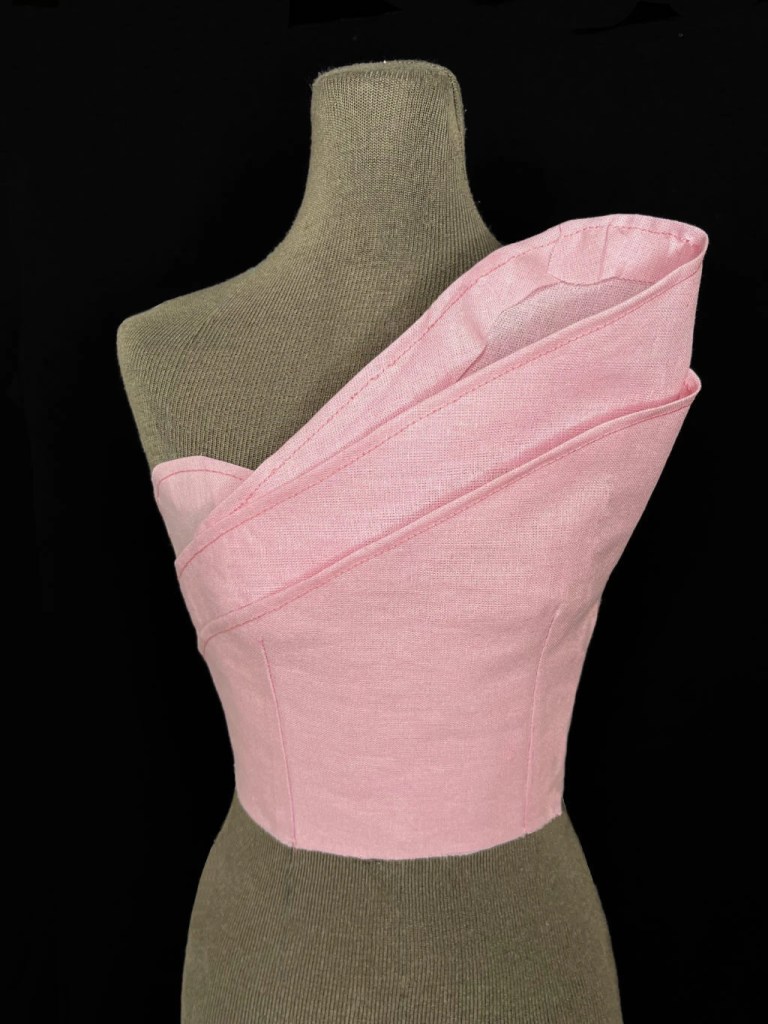
In the image below, you can see a bodice based on a picture from the book I drafted briskly. It is in the creative exercises section, where you have to figure out the pattern completely yourself. (The middle part is a little clumsy, as I wanted to proceed quickly. There should be a layer of lining or facing to hide the seam allowance. However, I thought it unfair to photoshop the photo 🙂 )


Conclusion
This publication starts with a very high-level summary and there is an overview at the beginning of each chapter. On 250 pages it contains about 160 sewing pattern designs, 50 fancy pattern design exercises and plenty of fascinating ideas.
If you master basic cut modifications and fancy to experiment with more exciting or challenging projects, this is the right book for you. Even if you already know how to make basic blocks, this publication is a great source of inspiration. The only part I miss is a well-made index that would help quickly direct the reader to the information they’re trying to find. Despite this lack, it is certainly worth having it in your book collection on sewing.
Thanks Anicka! Yes, I plan to make a muslin, using calico. I have made both blocks, muslins and skirts from my measurements in the past (about eight years ago) , so it’s not all new, but after a long gap it’s still quite a learning curve, especially as our body shape changes as we age. Thank you so much for your help, Hannah
Hi, I’m happy to see you’re making progress!
It is hard to tell how many darts you may need. However, If you have trousers with four darts at the front (2 at each half/side) and they suit you, you may try to “copy” those darts. You can also experiment with different dart lengths (the two darts on one side do not have to be the same length) and distances between darts.
What I would wholeheartedly recommend, is to create a muslin from a unicolour fabric (a prototype) and pin, or machine-baste, the darts and side seams and try multiple versions to see what fits you most. It is a little time-consuming process. Nonetheless, you will probably use the basic block for other skirt designs, therefore I think it is worth the effort.
You could also consider investing in a book on fitting. You can read my comparison of various books following the link below:
https://anicka.design/2023/02/17/succeed-in-fitting-garments-books-overview/
Have a nice day :).
Anicka
Hi Hannah, thank you for your comment and questions.
Antonio Donnano’s books are an amazing source of inspiration, but the instructions are sometimes very hard to understand.
Now, your question about the basic skirt block waist. Let’s look into it step-by-step. I’ll leave out the various Ts in the book if you don’t mind. I think it is more important to understand what is going on (no matter what letters are used to mark darts, waist, etc.):
– take your body measurements
– add ease to the hips (and waist, if you prefer to do so)
– you are going to draw one-half of the FONT and one-half of the BACK pattern piece. This means – one-half of the whole skirt
– drawing the hip line is easy
– measuring, deciding, and drawing the lengths is also easy
– now, the tricky waist:
-> (hips with ease – waist with ease) = some number
-> this “some number” indicates the total amount, by which your hips are wider than your waist.
-> however, you are drafting only one-half of the skirt. That means you have to divide this “some number” by 2. (Mathematically speaking you can do “some number”/2 or (hips with ease – waist with ease)/2. The result is the same. Let’s say, that “some number”/2 = 16 cm)
-> 16 cm is the total amount of “excess fabric” that needs to be “taken away” at the pattern waist to create a snug fit.
-> but, usually, you do not want to take away the whole 16 cm on the side seams only (8 cm at the FRONT and 8 cm at the BACK, for example). The final skirt probably wouldn’t look nice.
-> to distribute the 16 cm more evenly, you have to add darts at the FRONT and BACK.
-> there are some recommendations on dart widths (that they should not be wider than 3 cm). If you decide to use 3 cm for the FRONT and BACK dart (3 cm + 3 cm = 6 cm), you have to divide the rest of the “excess fabric” 10 cm (16 cm – 6 cm = 10 cm) between the FRONT and BACK side seams. This would result in 10/2 = 5 cm (5 cm for the FRONT side seam and 5 cm for the BACK side seam).
-> that being said, if you take away from the waist (and follow ALL instructions in the book), you are not going to make it too small.
I hope the process of basic skirt pattern-making is at least a little bit clearer. If you have any further questions, please feel free to contact me.
Anicka
Thank you Anicka. Your prompt and helpful reply made me look again at my measurements and I realised my partner had taken my waist measurement too low, so it appeared that I only had 6cm difference between my hips and waist to divide between darts and side seams. When I worked it out again using my smaller waist measurement I had 12cm to play with and your clear instructions made putting it all together work. I have made up two blocks, one using the above book and the other using Gillian Holman’s Pattern Cutting Made Easy; they use different methods to draft the block but you should get the same result, I know now (my blocks were different, which was worrying me, although I wasn’t sure if that was just because they were different designers).
Although I am slim (a size 12), my abdomen is quite large, which is why I am drafting my own skirt pattern as I am struggling to find skirts that fit properly. My waist/ abdomen/ hips measure 80/97/104cm. Obviously I don’t have much to play with in my 12cm but would you advise putting in two darts instead of one in each quarter? One of my skirts and several pairs of trousers I own and like have four darts at the front. I’m planning to make some short A Line skirts, I want them to be not too fitted at the front.
Thanks in advance 🙂
Hi. Your website is wonderful and I’m very grateful for the block calculator. I have found your website because I am searching for some help with Antonio Donnanno’s book, which I am making a skirt block from. I can’t quite understand the calculation for darts and waistline under the basic pencil skirt. He writes (page.37), ‘ to calculate the width of the darts, subtract half of the waist circumference from half of the hip circumference: the difference must be divided between the curves of the sides and front and back darts. For example: 1/2 Hip Circumference 50cm less 1/2 waist circumference 36=14cm total excess to use in the darts’.
E1-W and E1-W1 is the space to distribute between the gradual curve of the side seams from the hip line to the waistline (in this case 4+4)
-T2-T3 and T4-T-5 is the size of the darts in front and in back (in this case in front 3cm and in back 3cm)
It seems to me we are taking out fabric to make the darts instead of adding this to our waist circumference like some other blocks do, is this right, if so won’t the waist be too small?